How the Hospitality Industry Characteristics Influence Operational Practices
Introduction
The hospitality and service industries operate within a distinctive framework shaped by the fundamental nature of services. Unlike product-based industries, which focus on the production, storage, and distribution of tangible goods, hospitality organisations deliver experiences that are intangible, time-sensitive, and highly dependent on human interaction. These characteristics—including intangibility, perishability, variability, and customer participation—do not simply define the service itself; they directly shape how businesses must organise and manage their operations.
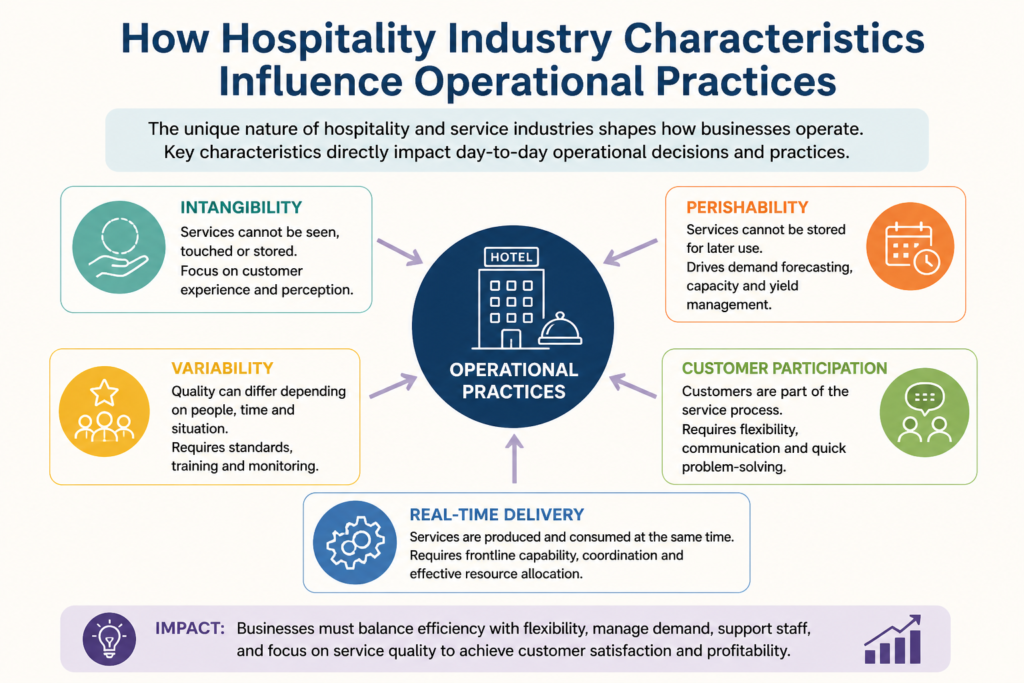
Operational practices in hospitality therefore extend beyond traditional efficiency models and require a more dynamic, responsive, and customer-focused approach. Activities such as demand forecasting, resource allocation, service delivery design, and quality management are all influenced by the need to operate in real time while maintaining consistent service standards. Analysing these relationships provides critical insight into why hospitality management differs fundamentally from operations in manufacturing or product-based environments.
Intangibility and Real-Time Service Delivery
A core characteristic of hospitality services is their intangible nature. Unlike physical goods, services cannot be touched, stored, or evaluated prior to consumption. Instead, they are experienced subjectively by the customer, often shaped by emotional and psychological responses. This has significant implications for operations, as quality cannot be verified through pre-delivery inspection in the same way as manufactured products.
Closely linked to intangibility is the simultaneity of production and consumption. Services are created and delivered at the same moment, meaning that operational performance must be managed in real time. There is little opportunity to correct errors before they affect the customer, and service failures are often experienced immediately. This creates a need for highly responsive operational systems and well-trained frontline staff who can make decisions quickly and effectively.
From an operational perspective, this shifts the focus away from back-end production control towards front-end service delivery. Managers must ensure that employees are equipped with both the technical knowledge and interpersonal skills required to deliver consistent service under varying conditions. As Lovelock and Wirtz (2021) argue, service operations are characterised by their immediacy, requiring organisations to prioritise responsiveness and adaptability over rigid process control.
Perishability and Capacity Management
Perishability is another defining characteristic of hospitality services and has profound implications for operational planning. Because services cannot be stored, any unused capacity represents a permanent loss of revenue. An empty hotel room, an unoccupied restaurant table, or an unsold ticket for a tour cannot be recovered once the service period has passed.
This creates a critical need for effective capacity management and demand forecasting. Hospitality organisations must anticipate fluctuations in demand and adjust their operations accordingly. Techniques such as reservation systems, overbooking strategies, and dynamic pricing are commonly used to maximise occupancy and revenue generation. Yield management, in particular, has become a central operational tool in industries such as hotels and airlines, allowing businesses to adjust pricing in response to demand patterns (Kimes, 1989).
However, managing capacity is not simply a matter of maximising utilisation. Overcrowding or excessive demand can negatively impact service quality, leading to longer waiting times, reduced staff attention, and diminished customer satisfaction. Operational decision-making must therefore balance revenue optimisation with the maintenance of service standards. This dual objective adds complexity to hospitality operations and requires careful coordination between demand management and service delivery systems.
Variability and the Need for Consistency
Service variability presents another significant operational challenge. Unlike manufactured goods, which can be standardised through controlled production processes, services are inherently variable due to their dependence on human interaction. Each service encounter is influenced by factors such as employee behaviour, customer expectations, timing, and environmental conditions.
This variability makes it difficult to ensure consistent service quality across different interactions. Customers may receive different experiences depending on who serves them, when they visit, or how busy the business is at the time. From an operational perspective, this introduces a level of uncertainty that must be actively managed.
To address this, hospitality organisations implement a range of practices aimed at reducing variability while preserving flexibility. These include standard operating procedures, detailed service protocols, employee training programmes, and performance monitoring systems. The goal is not to eliminate variability entirely—which is often impossible—but to ensure that it remains within acceptable limits.
Zeithaml, Bitner and Gremler (2018) highlight that consistency is a key determinant of customer satisfaction in service industries. As such, operational systems must be designed to support repeatable service standards while still allowing employees to personalise interactions when necessary. This balance between standardisation and personalisation is a defining feature of hospitality operations.
Customer Participation and Operational Complexity
One of the most distinctive aspects of hospitality services is the active role of the customer in the service process. Unlike in product-based industries, where production occurs independently of the end user, hospitality services are often co-created through interaction between employees and customers.
This co-creation introduces additional complexity into operations. Customers may have different expectations, preferences, and behaviours, all of which can influence the outcome of the service. For example, special requests, complaints, or changes in plans require immediate responses and may disrupt standard operational processes.
From an operational perspective, this necessitates a high degree of flexibility and adaptability. Employees must be empowered to make decisions in real time, and communication systems must support the rapid exchange of information across departments. Grönroos (2008) emphasises that value in service contexts emerges through interaction, reinforcing the idea that operations must be designed to accommodate customer involvement rather than control it.
This also has implications for service design. Physical environments, service flows, and staffing arrangements must all be structured in a way that facilitates positive customer interactions. Poorly designed systems can lead to delays, confusion, or dissatisfaction, even if the technical aspects of the service are delivered effectively.
Balancing Efficiency and Flexibility
The characteristics of hospitality services create an inherent tension between efficiency and flexibility. On one hand, organisations must manage costs, optimise resource utilisation, and maintain profitability. On the other hand, they must remain responsive to changing demand and individual customer needs.
Traditional operations management approaches, which emphasise standardisation and efficiency, are often insufficient in this context. Hospitality organisations must instead adopt more flexible and adaptive operational models. This may involve cross-trained staff, modular service processes, and decentralised decision-making structures.
The challenge lies in achieving efficiency without compromising the ability to respond to variability and uncertainty. Overly rigid systems can reduce responsiveness and negatively affect customer experience, while excessive flexibility can lead to inefficiencies and increased costs. Effective operational management therefore requires a careful balance between these competing priorities.
Operational Implications for Management
The characteristics of the hospitality industry influence virtually every aspect of operational practice. Managers must design systems that account for real-time service delivery, fluctuating demand, and the central role of human interaction. This requires a holistic approach to operations management, where staffing, service design, demand management, and quality control are integrated into a coherent strategy.
In contrast to product-based organisations, where operational success is often measured through efficiency and output, hospitality organisations must also consider customer experience as a core performance indicator. This adds an additional layer of complexity, as operational decisions must be evaluated not only in terms of cost and productivity but also in terms of their impact on customer satisfaction.
Ultimately, the effectiveness of hospitality operations depends on the ability to align organisational processes with the unique characteristics of services. Businesses that successfully manage this alignment are better positioned to deliver consistent, high-quality experiences while maintaining operational efficiency.
References
Grönroos, C. (2008) ‘Service logic revisited: who creates value? And who co‐creates?’, European Business Review, 20(4), pp. 298–314.
Kimes, S.E. (1989) ‘Yield management: A tool for capacity-constrained service firms’, Journal of Operations Management, 8(4), pp. 348–363.
Lovelock, C. and Wirtz, J. (2021) Services Marketing: People, Technology, Strategy. 9th edn. Singapore: World Scientific.
Zeithaml, V.A., Bitner, M.J. and Gremler, D.D. (2018) Services Marketing: Integrating Customer Focus Across the Firm. 7th edn. New York: McGraw-Hill.
View Courses in Hospitality and Tourism…
Start your journey in hospitality and tourism with an accredited Click College course. Enrol today and build the skills, knowledge, and confidence to progress into a management role.







Recent Posts
How to Build Trust Before a Customer Buys
How to Build Trust Before a Customer Buys Before a customer buys from an unfamiliar business, they are making more than a price comparison. They are deciding whether the offer is genuine, whether the organisation will deliver what it promises and whether help will be available if something goes wrong. That is why trust is […]
Why Customers Switch: The Trust and Value Signals That Drive Churn
Why Customers Switch: The Trust and Value Signals That Drive Churn Customers rarely switch simply because a competitor is cheaper. They switch when the relationship no longer feels safe, fair or worth the effort. A price rise may trigger the search, but unclear charges, poor support, weak proof and uncertainty about what happens next are […]
How to Find and Fix Friction in the Buying Journey
How to Find and Fix Friction in the Buying Journey Customers rarely decide not to buy for one dramatic reason. More often, small difficulties build up: a confusing product page, unclear pricing, a slow reply, an awkward form, conflicting information or a delivery promise that feels uncertain. Each issue may appear minor in isolation. Together, […]