Demand Management in Hospitality: How Industry Characteristics Shape Capacity and Revenue Strategies
Introduction
Demand management is a critical operational function in the hospitality and service industries, shaped directly by the unique characteristics of service delivery. Unlike product-based industries, where goods can be produced in advance and stored for future sale, hospitality services are perishable, time-sensitive, and consumed at the point of delivery. These features create a challenging environment in which organisations must carefully balance supply and demand to maximise both efficiency and profitability.
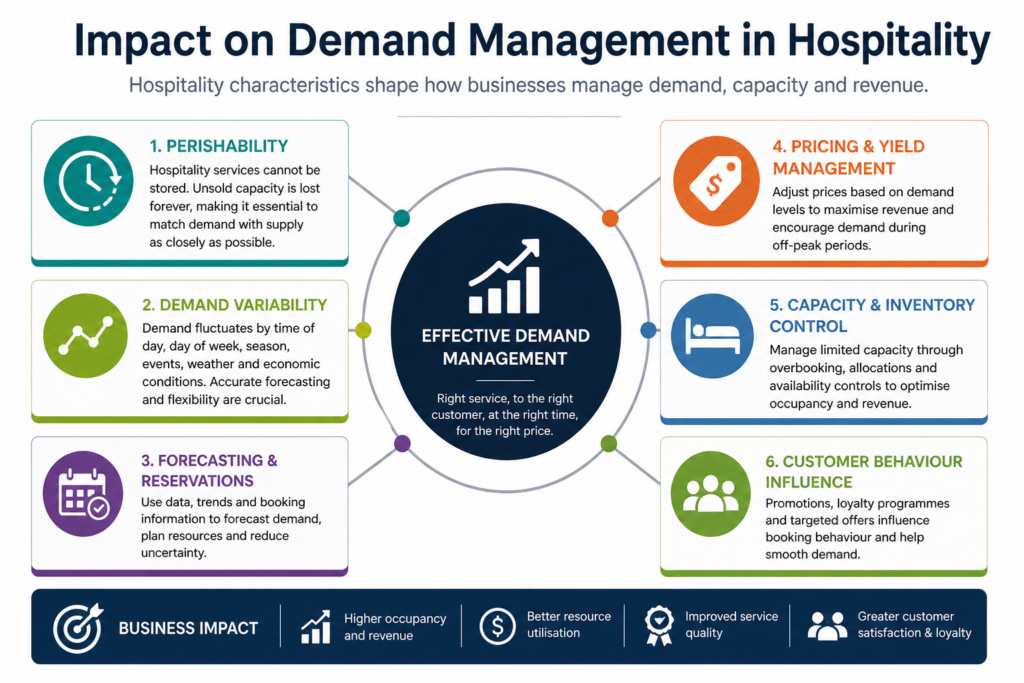
The ability to manage demand effectively is therefore not simply an operational task but a strategic necessity. Hospitality businesses must anticipate fluctuations in customer demand, allocate resources accordingly, and implement pricing and booking strategies that optimise capacity utilisation while maintaining service quality.
The Impact of Perishability on Demand Management
One of the most influential characteristics shaping demand management in hospitality is perishability. Because services cannot be stored, any unused capacity represents lost revenue that cannot be recovered. An empty hotel room, an unsold airline seat, or a vacant restaurant table during service hours is effectively wasted capacity.
This creates strong pressure on organisations to ensure that demand matches available supply as closely as possible. Unlike manufacturing firms, which can build inventory during low-demand periods, hospitality businesses must operate within fixed time constraints. This makes accurate demand forecasting essential.
Operational practices are therefore designed to reduce the risk of underutilisation while avoiding overcapacity, which can negatively impact service quality. Managers must continuously monitor demand patterns and adjust their strategies to ensure that resources are used efficiently.
Demand Variability and Forecasting Challenges
Demand in the hospitality industry is rarely stable. It is influenced by a wide range of factors, including time of day, day of the week, seasonality, public holidays, local events, and broader economic conditions. For example, hotels may experience high occupancy during holiday seasons, while restaurants may see peak demand during evenings and weekends.
This variability makes demand forecasting both essential and complex. Organisations must analyse historical data, market trends, and external factors to predict customer behaviour. However, forecasts are rarely perfect, and unexpected changes can disrupt operational plans.
To manage this uncertainty, hospitality businesses often adopt flexible operational practices that allow them to respond quickly to changes in demand. This includes adjusting staffing levels, modifying service capacity, and implementing dynamic pricing strategies.
Yield Management and Dynamic Pricing
One of the most widely used approaches to demand management in hospitality is yield management, also known as revenue management. This strategy involves adjusting prices based on demand levels to maximise revenue from available capacity.
For example, hotels may increase room prices during periods of high demand and offer discounts during quieter periods to attract customers. Similarly, airlines use dynamic pricing to optimise seat occupancy and revenue.
Kimes (1989) highlights that yield management is particularly effective in industries with fixed capacity and perishable inventory, making it highly relevant to hospitality operations. By influencing customer behaviour through pricing, organisations can better align demand with available capacity.
However, pricing strategies must be managed carefully to avoid negative customer perceptions. Excessive price fluctuations or perceived unfairness can damage customer trust and long-term loyalty.
Reservation Systems and Demand Control
Reservation systems play a crucial role in managing demand within hospitality operations. By allowing customers to book services in advance, organisations can better predict demand and allocate resources accordingly.
These systems provide valuable data that can be used to inform forecasting, staffing decisions, and capacity planning. They also help to reduce uncertainty by securing future demand.
In addition, practices such as overbooking are sometimes used to compensate for expected cancellations or no-shows. While this can improve capacity utilisation, it must be carefully managed to avoid service failures and customer dissatisfaction.
The use of technology in reservation systems has further enhanced demand management capabilities, enabling real-time data analysis and more accurate forecasting.
Balancing Demand and Service Quality
While maximising capacity utilisation is important, hospitality organisations must also consider the impact of demand on service quality. High levels of demand can strain resources, leading to longer waiting times, reduced staff attention, and lower customer satisfaction.
This creates a need to balance demand management strategies with service delivery capabilities. Overloading the system may increase short-term revenue but can damage long-term customer relationships and brand reputation.
Zeithaml, Bitner and Gremler (2018) emphasise that service quality is closely linked to customer perceptions, meaning that operational decisions must consider both efficiency and experience. Maintaining this balance is a key challenge in hospitality management.
The Role of Customer Behaviour in Demand Management
Customer behaviour plays a significant role in shaping demand patterns. Booking habits, preferences, and responsiveness to pricing strategies all influence how demand is distributed over time.
For example, discounts may encourage customers to shift their usage to off-peak periods, helping to smooth demand fluctuations. Similarly, loyalty programmes and promotions can influence repeat behaviour and stabilise demand.
Understanding customer behaviour allows organisations to design more effective demand management strategies. This requires the use of data analytics and customer insights to identify patterns and predict future trends.
Case Application: Restaurant Demand Across the Week
A practical example of demand management can be seen in a restaurant that experiences high demand on weekends but lower customer numbers during weekdays. To address this imbalance, the restaurant may introduce special offers, discounted menus, or promotional events during quieter periods.
At the same time, staffing levels and reservations are adjusted to accommodate peak demand during weekends. This approach helps to maximise revenue across the entire week while maintaining service quality.
This example demonstrates how hospitality businesses must actively manage demand rather than simply respond to it, using a combination of pricing, marketing, and operational adjustments.
Strategic Importance of Demand Management
Demand management is a central component of operational strategy in hospitality. It influences not only revenue generation but also staffing, resource allocation, and service delivery.
Effective demand management requires an integrated approach that combines forecasting, pricing strategies, customer insights, and operational planning. Organisations that manage demand successfully are better positioned to optimise capacity, control costs, and deliver consistent service quality.
In contrast to product-based industries, where production can be adjusted to meet demand, hospitality businesses must align demand with fixed capacity. This makes demand management a critical factor in achieving both operational efficiency and long-term competitiveness.
References
Kimes, S.E. (1989) ‘Yield management: A tool for capacity-constrained service firms’, Journal of Operations Management, 8(4), pp. 348–363.
Lovelock, C. and Wirtz, J. (2021) Services Marketing: People, Technology, Strategy. 9th edn. Singapore: World Scientific.
Zeithaml, V.A., Bitner, M.J. and Gremler, D.D. (2018) Services Marketing: Integrating Customer Focus Across the Firm. 7th edn. New York: McGraw-Hill.
View Courses in Hospitality and Tourism…
Start your journey in hospitality and tourism with an accredited Click College course. Enrol today and build the skills, knowledge, and confidence to progress into a management role.







Recent Posts
How to Build Trust Before a Customer Buys
How to Build Trust Before a Customer Buys Before a customer buys from an unfamiliar business, they are making more than a price comparison. They are deciding whether the offer is genuine, whether the organisation will deliver what it promises and whether help will be available if something goes wrong. That is why trust is […]
Why Customers Switch: The Trust and Value Signals That Drive Churn
Why Customers Switch: The Trust and Value Signals That Drive Churn Customers rarely switch simply because a competitor is cheaper. They switch when the relationship no longer feels safe, fair or worth the effort. A price rise may trigger the search, but unclear charges, poor support, weak proof and uncertainty about what happens next are […]
How to Find and Fix Friction in the Buying Journey
How to Find and Fix Friction in the Buying Journey Customers rarely decide not to buy for one dramatic reason. More often, small difficulties build up: a confusing product page, unclear pricing, a slow reply, an awkward form, conflicting information or a delivery promise that feels uncertain. Each issue may appear minor in isolation. Together, […]