Staffing in the Hospitality Industry: How Service Characteristics Shape Workforce Management
Introduction
Staffing represents one of the most critical operational functions within the hospitality and service industries. Unlike product-based sectors, where production systems can operate independently of the end customer, hospitality organisations rely heavily on human interaction to deliver value. Employees are not simply part of the operational process; they are central to the customer experience itself.
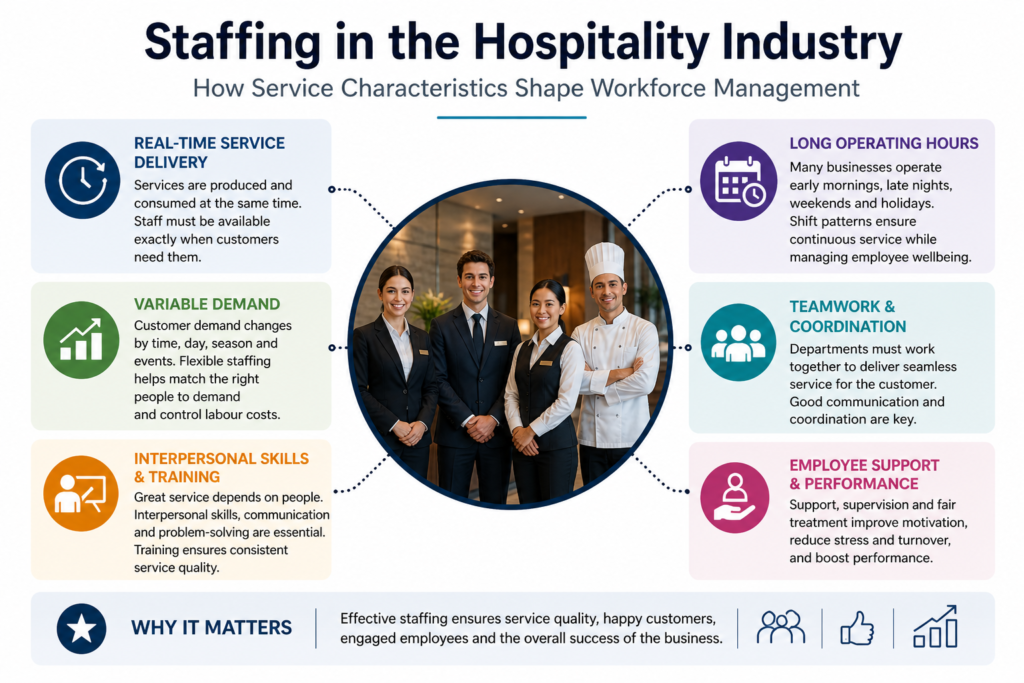
The distinctive characteristics of hospitality—such as simultaneous production and consumption, variable demand, customer participation, and extended operating hours—directly influence how organisations recruit, schedule, train, and manage their workforce. As a result, staffing in hospitality is not only an operational concern but also a strategic priority that affects both service quality and organisational performance.
Real-Time Service Delivery and Workforce Alignment
A defining characteristic of hospitality services is the simultaneity of production and consumption. Services are delivered and experienced in real time, meaning that employees must be available at the exact moment customers require assistance. A hotel receptionist must be present when guests arrive, and restaurant staff must be available during peak dining periods.
This creates a direct relationship between customer demand and staffing levels. Unlike manufacturing environments, where production can be planned in advance and inventory stored, hospitality organisations cannot separate service delivery from consumption. As a result, workforce planning must be highly responsive and closely aligned with demand patterns.
From an operational perspective, this requires precise scheduling systems and real-time adjustments to staffing levels. Managers must anticipate demand fluctuations and ensure that sufficient staff are available without creating inefficiencies. Failure to achieve this balance can result in service delays, reduced quality, and customer dissatisfaction.
Variable Demand and Flexible Staffing Strategies
Demand in the hospitality industry is inherently variable and often unpredictable. It can fluctuate based on time of day, day of the week, seasonality, local events, and broader economic conditions. For example, restaurants typically experience peak demand during evenings and weekends, while hotels may see increased occupancy during holidays or major events.
To manage this variability, hospitality organisations must adopt flexible staffing strategies. These may include the use of part-time employees, temporary contracts, casual labour, and shift-based working arrangements. Such flexibility allows businesses to adjust staffing levels in response to changing demand while controlling labour costs.
However, flexible staffing also introduces challenges. High reliance on part-time or temporary staff may affect consistency and service quality if employees are not adequately trained or integrated into the organisation. As a result, managers must balance flexibility with the need for a stable and skilled workforce.
The Importance of Interpersonal Skills and Training
Because service quality in hospitality is closely linked to employee behaviour, staffing decisions extend beyond technical competence. Interpersonal skills—such as communication, empathy, problem-solving, and teamwork—are essential for delivering positive customer experiences.
Employees in hospitality roles must be able to interact effectively with a diverse range of customers, respond to requests, and manage complaints in real time. These interactions play a significant role in shaping customer perceptions of the service. As Bowen and Schneider (2014) note, frontline employees are instrumental in creating a positive service climate, which directly influences customer satisfaction and loyalty.
Training and development are therefore critical components of staffing practices. Organisations must invest in both initial training and ongoing professional development to ensure that employees can deliver consistent service quality. This includes not only technical skills but also behavioural standards and communication techniques.
Managing Extended Operating Hours
Hospitality businesses often operate across extended hours, including evenings, weekends, and public holidays. In some cases, such as hotels and transport services, operations may run continuously for twenty-four hours a day.
This creates additional complexity in workforce management. Staffing schedules must be designed to ensure continuous service coverage while also considering employee wellbeing and legal requirements. Shift work, rota systems, and workforce planning tools are essential for managing these demands effectively.
Managers must also address issues such as fatigue, work-life balance, and employee retention, which can be affected by irregular working hours. Poor management of these factors can lead to decreased employee performance and higher staff turnover, ultimately impacting service quality.
Coordination and Team-Based Service Delivery
Hospitality services are often delivered through coordinated efforts across multiple departments. In a hotel, for example, reception, housekeeping, food and beverage, and maintenance teams must work together to provide a seamless guest experience. Similarly, in a restaurant, coordination between kitchen and front-of-house staff is essential for efficient service delivery.
This interdependence means that staffing is not only about individual roles but also about teamwork and communication. Weaknesses in one area can affect the entire service process, leading to delays or service failures.
Operational practices must therefore support collaboration through clear communication systems, defined roles, and effective supervision. Cross-training employees can also enhance flexibility and improve coordination across departments.
High-Pressure Environments and Employee Support
Hospitality work often involves high-pressure conditions, particularly during peak service periods. Employees may need to manage large volumes of customers, respond to complaints, and perform time-sensitive tasks simultaneously. These pressures can affect performance and increase the risk of service errors.
To address this, organisations must provide appropriate support structures, including training, supervision, and clear communication channels. Managers play a key role in maintaining morale and ensuring that employees are equipped to handle demanding situations.
Creating a supportive work environment can improve employee satisfaction and performance, which in turn enhances service quality. This highlights the importance of human resource management as a core element of hospitality operations.
Case Application: Staffing During Peak Check-In Periods
A practical example of how service characteristics influence staffing can be observed in hotel check-in operations. Many hotels experience peak demand in the late afternoon when guests arrive simultaneously. During this period, the front desk may become crowded, luggage assistance is required, and housekeeping must prepare rooms efficiently.
To manage this, hotels often implement staggered shifts, increase staffing levels during peak hours, and utilise part-time employees. This ensures that service is delivered efficiently and that waiting times are minimised.
This example illustrates how staffing decisions are directly influenced by the time-sensitive and demand-driven nature of hospitality services. It also demonstrates the importance of aligning workforce planning with customer expectations and operational requirements.
Strategic Importance of Staffing in Hospitality
Staffing in hospitality is not simply an operational necessity but a strategic factor that influences organisational success. Employees play a central role in delivering service quality, shaping customer experiences, and building long-term relationships.
Effective workforce management requires a balance between efficiency, flexibility, and quality. Organisations must design staffing systems that can respond to variability while maintaining consistent service standards. This involves integrating recruitment, training, scheduling, and performance management into a cohesive strategy.
In contrast to product-based industries, where value is embedded in the physical product, hospitality organisations rely on people as the primary source of value creation. This makes staffing one of the most important areas of operational focus.
References
Bowen, D.E. and Schneider, B. (2014) ‘A service climate synthesis and future research agenda’, Journal of Service Research, 17(1), pp. 5–22.
Grönroos, C. (2008) ‘Service logic revisited: who creates value? And who co‐creates?’, European Business Review, 20(4), pp. 298–314.
Lovelock, C. and Wirtz, J. (2021) Services Marketing: People, Technology, Strategy. 9th edn. Singapore: World Scientific.
Zeithaml, V.A., Bitner, M.J. and Gremler, D.D. (2018) Services Marketing: Integrating Customer Focus Across the Firm. 7th edn. New York: McGraw-Hill
View Courses in Hospitality and Tourism…
Start your journey in hospitality and tourism with an accredited Click College course. Enrol today and build the skills, knowledge, and confidence to progress into a management role.







Recent Posts
Professional Diploma or Higher Qualification Pathway: Which Should You Choose?
Professional Diploma or Higher Qualification Pathway: Which Should You Choose? Choosing the right online qualification is not always simply a question of choosing the longest course or the highest level. For many learners, the better question is: what kind of study route fits my goals right now? Some learners want a focused qualification in one […]
Professional Diploma in Leadership and Management: Course Guide
Professional Diploma in Leadership and Management: Course Guide A Professional Diploma in Leadership and Management is designed for learners who want to develop advanced leadership, strategic thinking and organisational management skills without committing immediately to a full degree programme. Leadership and management are essential in almost every sector. Whether you work in business, education, hospitality, […]
Professional Diploma in Business Management: Who Is It For?
Professional Diploma in Business Management: Who Is It For? A Professional Diploma in Business Management is designed for learners who want to build practical business knowledge without committing immediately to a full degree or long higher education programme. It can be a useful option for people who want to understand how organisations work, how teams […]