Customer Variability in Hospitality: Managing Different Guest Needs
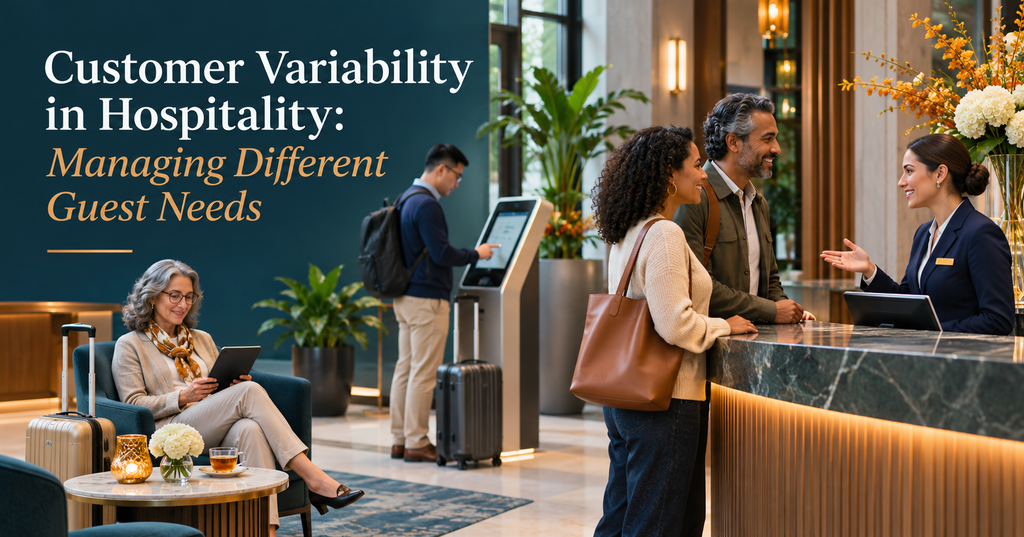
One hotel guest wants to collect a key and reach their room quickly. Another needs help understanding the check-in system. A third arrives with a request that requires coordination between reception and housekeeping.
Customer variability in hospitality means differences in when guests arrive, what they need, how they use services and what they value. These differences change the work staff must perform. Managing them well means adapting the service while keeping core standards—such as accuracy, cleanliness, respectful communication and reliable follow-through—consistent.
The aim is to provide a dependable experience that can respond to individual circumstances. A short, efficient welcome and a longer, supported check-in can both meet the same professional standard.
What is customer variability in hospitality?
Hospitality services involve participation by the guest. Customers make bookings, provide information, choose options, ask questions and interact with staff and systems. Their different circumstances can therefore affect how the service operates.
Service-management researcher Frances X. Frei identifies five forms of customer-introduced variability: differences in arrival, requests, capability, effort and personal preferences.[1] The following table applies those categories to illustrative hotel situations.
| Type of variability | Illustrative hotel example | Operational question |
|---|---|---|
| Arrival | Several guests arrive together after a delayed train. | Can reception handle a short surge in demand? |
| Request | A guest asks for a cot or a different room arrangement. | Who must check availability and confirm the request? |
| Capability | A guest is unfamiliar with the hotel’s digital check-in system. | What assistance or alternative route is available? |
| Effort | One guest completes optional registration before arrival; another prefers to do it at reception. | Can both routes work without unnecessary duplication? |
| Preference | One guest welcomes conversation; another wants a brief interaction. | How can staff establish the preferred style? |
These categories help explain operational differences; they are not labels for judging guests. Difficulty with a system may reflect unclear instructions, an inaccessible design or an unfamiliar language. Staff should investigate the barrier before assuming someone lacks ability or is unwilling to participate.
Customer variability also differs from inconsistency in employee performance. Guests can have different needs even when every team member works competently. For the wider picture, see Variability in Hospitality Service Delivery: Implications for Consistency, Customer Satisfaction and Managerial Control.
How different guest needs change the workload
The following scenarios are fictional teaching examples. They illustrate possible responses, rather than describing measured outcomes at a named hotel.
Scenario one: a guest who values speed
Alex has stayed at the hotel before, has completed the available pre-arrival steps and asks for a quick check-in before a meeting.
The receptionist confirms the necessary details, provides the key and explains essential information concisely. Additional information remains available if Alex wants it later.
Here, adapting the service means reducing unnecessary repetition. Staff still complete required checks and communicate important information. Speed does not justify skipping the steps that protect accuracy and security.
Scenario two: a guest unfamiliar with the system
Samira is visiting the hotel for the first time. The kiosk instructions are unclear to her, and she asks to speak to someone.
A receptionist offers an assisted check-in, explains the next steps in plain language and checks whether anything needs clarification. Samira receives the same accurate booking confirmation and essential arrival information as Alex, through a more supported interaction.
The extra time is a legitimate part of delivering the service. If the hotel plans only around guests who can use the kiosk independently, its capacity assumptions exclude those who need another route.
Scenario three: a request involving several departments
Jordan arrives with a child and asks whether a cot requested during booking has been placed in the room.
Reception checks the recorded request and contacts housekeeping to confirm readiness. If the request has not yet been fulfilled, staff explain what can be arranged and provide a realistic update.
The request creates coordination work as well as a customer conversation. A helpful response depends on reliable information, a clear owner and confirmation that the agreed action has happened.
These examples do not imply that returning guests always want speed, first-time visitors always need assistance or families always request additional equipment. Staff should establish the actual need.
Consistent standards can support different experiences
Consistency is most useful when it describes what guests should be able to rely on.
Every guest should receive accurate information, professional treatment and a clear explanation of what happens next. The length, channel and style of the interaction can vary.
| Core standard | What should remain dependable | What can adapt |
|---|---|---|
| Accurate check-in | Booking details and necessary checks are completed correctly. | Assisted or self-service route, with appropriate support. |
| Clear communication | Essential information is understandable and reliable. | Pace, format, level of explanation and communication channel. |
| Request handling | Staff check feasibility, assign responsibility and confirm the outcome. | The arrangement offered within available facilities and agreed terms. |
| Respectful welcome | The guest is acknowledged and treated professionally. | Amount of conversation and degree of assistance. |
| Reliable updates | Promises are realistic and followed through. | How and when updates are delivered, as agreed with the guest. |
A fixed script can remind staff about essential information. It becomes less useful when employees must repeat every sentence regardless of the guest’s situation.
For example, staff might ask whether a guest would prefer a brief overview or more detailed guidance. The answer helps shape the conversation without removing the hotel’s responsibility to explain essential matters.
VisitEngland’s inclusive-welcome guidance recommends clear communication, listening and asking whether assistance is wanted and how it can help.[2] This provides a practical foundation for adapting support without making assumptions.
Arrival patterns: why averages can hide pressure
Customer variability includes the timing of demand. A hotel expecting a manageable number of arrivals across an afternoon may still face a queue if many guests reach reception together.
Consider two illustrative afternoons with the same number of arrivals. On the first, guests arrive steadily. On the second, an event finishes nearby and several parties arrive within minutes. Total demand is similar, but the pressure at reception is different.
Managers can examine expected group arrivals, transport connections, event timings and previous arrival patterns. Where feasible, this information can inform shift overlaps, room preparation and the timing of other duties.
Expected arrival times remain estimates. Delayed transport or changing guest plans can alter the pattern, so the operation also needs a practical response when arrivals differ from the forecast.
For broader preparation across departments, see How Hotels Can Prepare for Peak Season: A Practical Operations Checklist.
Requests and preferences: check before promising
A guest request may look simple at reception but depend on work elsewhere. An early arrival may require housekeeping coordination; a room-location preference may depend on availability.
A useful response has three parts: establish the need, check what is feasible and confirm what has actually been agreed.
For example, staff should distinguish between recording an early-check-in request and confirming that a room will be available early. Clear wording helps guests plan and prevents another colleague from inheriting a promise the hotel cannot fulfil.
Preferences also differ in significance. A preferred view and an access requirement should not automatically enter the same discretionary queue. Staff need to understand the purpose of the request and follow the appropriate procedures.
Familiarity with systems: design help into the service
Self-service can be convenient, but a digital route still requires guests to understand instructions, provide information and complete tasks.
Hotels should examine where guests abandon a process or ask for help. Repeated questions at the same screen may indicate a design problem rather than a training need for customers.
Practical improvements might include clearer instructions, fewer repeated entries, more visible assistance and a supported alternative. These are options to assess against the hotel’s actual systems and guest feedback.
A guest should not have to fail repeatedly before receiving help. Making assistance easy to find allows staff to intervene earlier and identify recurring barriers.
A practical method: ask, confirm, coordinate and check
The following four-step method is an editorial tool for applying the ideas in this article.
- Ask: Establish what the guest needs and their preferred way of receiving assistance.
- Confirm: Explain the available options, limitations and agreed next step.
- Coordinate: Give any cross-department action a clear owner and pass on the relevant information.
- Check: Confirm that the action happened and that the guest received the promised update.
For Jordan’s cot request, this means checking the booking note, confirming availability, assigning the action to the appropriate colleague and verifying completion.
For Samira’s check-in, it means offering support, explaining the process, completing the necessary steps and checking that the essential information is clear.
The method can remain consistent while the response changes.
How can managers tell whether the approach is working?
Review waiting times alongside the reasons guests need assistance. A longer interaction may represent effective support, while a shorter one may leave a guest confused.
Useful evidence includes repeated requests, booking notes that fail to reach the right team, guest feedback on communication and processes that require frequent staff intervention.
Discuss these patterns with employees. If the same request regularly causes disruption, it may need a planned service option, clearer information or a better handover.
Customer variability is an expected feature of hospitality. Good management makes room for differences while ensuring that the hotel’s essential promises remain reliable.
Develop your hospitality management knowledge
Understanding different guest needs helps connect customer experience with communication, workflow and operational planning. Click College offers focused qualifications and broader subject pathways:
- Focused study: the Professional Diploma in Hotel Management (EduQual Level 5) and Professional Diploma in Hospitality Management (EduQual Level 5) are each 40-credit options.
- Foundation knowledge: the Higher International Certificate in Hospitality and Tourism Management (EduQual Level 4) provides a 120-credit introduction.
- Broader management study: the Higher International Diploma in Hospitality and Tourism Management (EduQual Level 5) extends study to 240 credits in total, incorporating Level 4.
- Advanced study: the International Graduate Diploma in Hospitality and Tourism Management (Level 6) provides a 360-credit route covering advanced hospitality and tourism management.
Compare Click College’s Hospitality and Tourism Management pathways and choose the course that supports your learning goals.
Frequently asked questions
What is customer variability in hospitality?
It is variation in guests’ arrival patterns, requests, familiarity or ability to use services, participation and preferences. These differences affect the tasks, time and coordination needed to deliver service.
Is customer variability the same as poor service consistency?
No. Customer variability concerns differences between guests and their circumstances. Poor consistency concerns unreliable delivery. A hotel can adapt its approach while maintaining dependable standards.
How can hotels personalise service without lowering standards?
Keep essential requirements consistent, including accurate information, necessary checks and reliable follow-through. Adapt the communication, assistance and feasible arrangements around those requirements.
Should every guest use the same check-in process?
The hotel needs reliable checks and accurate records, but guests may need different ways to complete them. Supported and self-service routes can serve the same purpose when properly designed.
Does good service mean agreeing to every request?
No. Staff should establish the need, check feasibility and explain the available options honestly. A clear, realistic response is more dependable than an unsupported promise.
References
[2] VisitEngland: Accessible and Inclusive Tourism Toolkit for Businesses — Section 4: An inclusive welcome. Accessed 15 November 2026.
Recent Posts
Staff Morale in Hospitality: How Employee Experience Shapes Guest Service
Staff Morale in Hospitality: How Employee Experience Shapes Guest Service A receptionist answers the same room-readiness question for the fourth time. Housekeeping is waiting for replacement linen, arrivals are building up and the duty manager is already handling another problem. Everyone is working hard, but guests are receiving different answers. Staff morale in hospitality can […]
Hospitality Staffing Shortages: Why Vacancies Become Service Problems
Hospitality Staffing Shortages: Why Vacancies Become Service Problems A hotel guest sees a queue at reception and a room that is not ready. Behind those visible problems may be two housekeeping vacancies, an unfilled reception post and a supervisor trying to cover both departments. Hospitality staffing shortages occur when the available workforce cannot meet the […]
What Makes Organisational Communication Effective? Key Features Explained
What Makes Organisational Communication Effective? Key Features Explained Introduction Communication within organisations forms the backbone of everyday operations, decision-making, collaboration and team cohesion. Whether an organisation is small or multinational, communication shapes how smoothly tasks are completed, how people relate to one another, and how effectively the organisation responds to challenges. To truly understand the […]