How Organisations Work: Exploring Purpose and Key Characteristics
Introduction
Organisations play a vital role in society by meeting needs, delivering services, and achieving specific goals. From small local businesses to large public bodies and charities, each type of organisation exists for a particular purpose and operates in a unique way. Understanding how organisations work helps us recognise why they are structured differently and how their objectives influence the way they function.
This blog explores the purpose and key characteristics of different types of organisations, providing a foundation for understanding their roles in the economy and wider society.
What Is a Business Organisation?
A business organisation is a structured system designed to coordinate people, resources and activities in order to achieve shared goals. These goals may relate to profit, service delivery, community benefit or social improvement. Regardless of size, every organisation must manage resources such as people, materials, finance, information and equipment in a purposeful way.
Even small one-person enterprises require organisation. A self-employed decorator, for example, must plan work, organise tools, manage customer bookings and control finances. In larger organisations, these tasks are distributed across departments and teams, with managers ensuring that the structure supports efficiency and productivity.
Organisations also operate within wider networks. They depend on suppliers, customers, regulators, financial institutions and local communities. This means organisational decisions are shaped not only by internal priorities but also by external influences and expectations.
Below is a simple diagram showing how an organisation coordinates inputs to produce outputs.
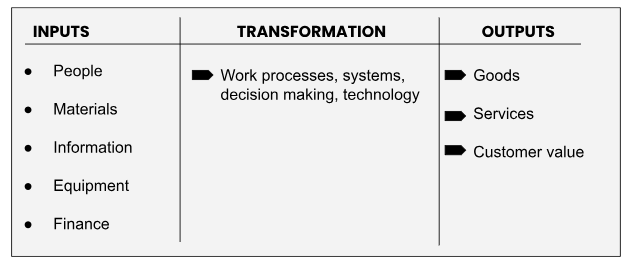
This is known as the “input–process–output” (IPO) model and is a helpful way to understand how organisations operate at a basic level.
The Purpose of Business Organisations
Although organisations differ in size, sector and strategy, they share several common purposes.
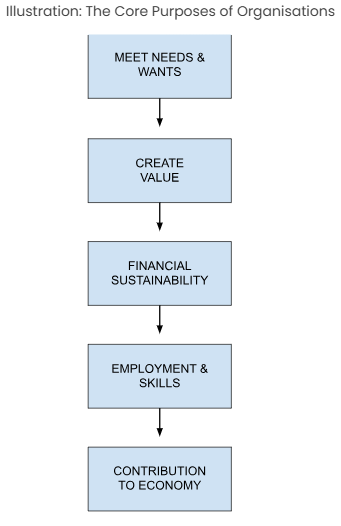
One key purpose is meeting needs and wants. Businesses identify what customers require or desire and develop goods or services to meet these demands. Another purpose is value creation. Organisations convert resources such as labour, materials and technology into useful outputs. Customers choose to pay for these outputs because they perceive them as valuable.
Financial sustainability is also important. Organisations must generate enough income to cover costs; otherwise, they cannot continue operating. For private-sector firms, this often means aiming for profit. For charities and public-sector organisations, this means maintaining sufficient funding and using resources efficiently.
Organisations also provide employment and develop skills. By offering training and meaningful work, they contribute to economic activity and individual career development. They also support wider society through taxation, purchasing, innovation, community support and participation in supply chains.
Types of Organisations
The contemporary business environment includes three major organisational sectors: private, public and third sector. Each type has a different purpose, ownership structure and source of funding.
Private Sector Organisations
Private-sector organisations are owned by individuals, families or shareholders. Their primary objective is usually profit, although many also adopt ethical or social goals. They rely on revenue from selling goods or services.
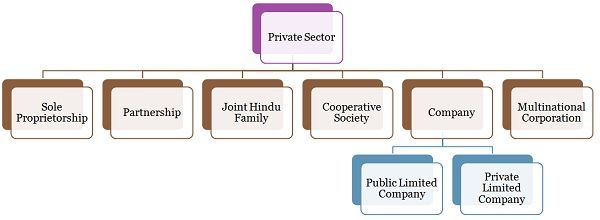
Common examples include retailers, manufacturing firms, cafés, restaurants, construction companies and digital service providers.
Characteristics include private ownership, income from trading activities, competition and the need for financial sustainability.
Public Sector Organisations
Public-sector organisations are owned and funded by the government, mainly through taxation. Their purpose is to provide essential public services such as healthcare, education, policing and public transport.
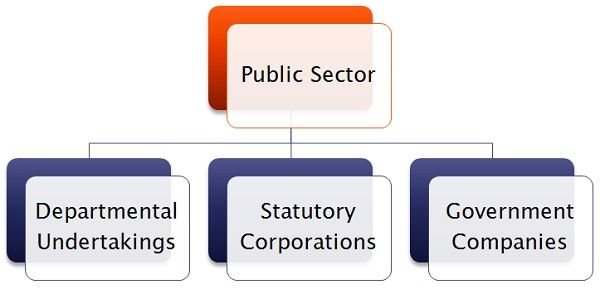
Performance is measured by service quality and value for money rather than profit. These organisations are accountable to the public and must operate in line with national policy and legal requirements.
Third Sector Organisations
Third-sector organisations include charities, voluntary groups, social enterprises, cooperatives and community interest companies (CICs). Their primary purpose is social, community-based or environmental benefit.
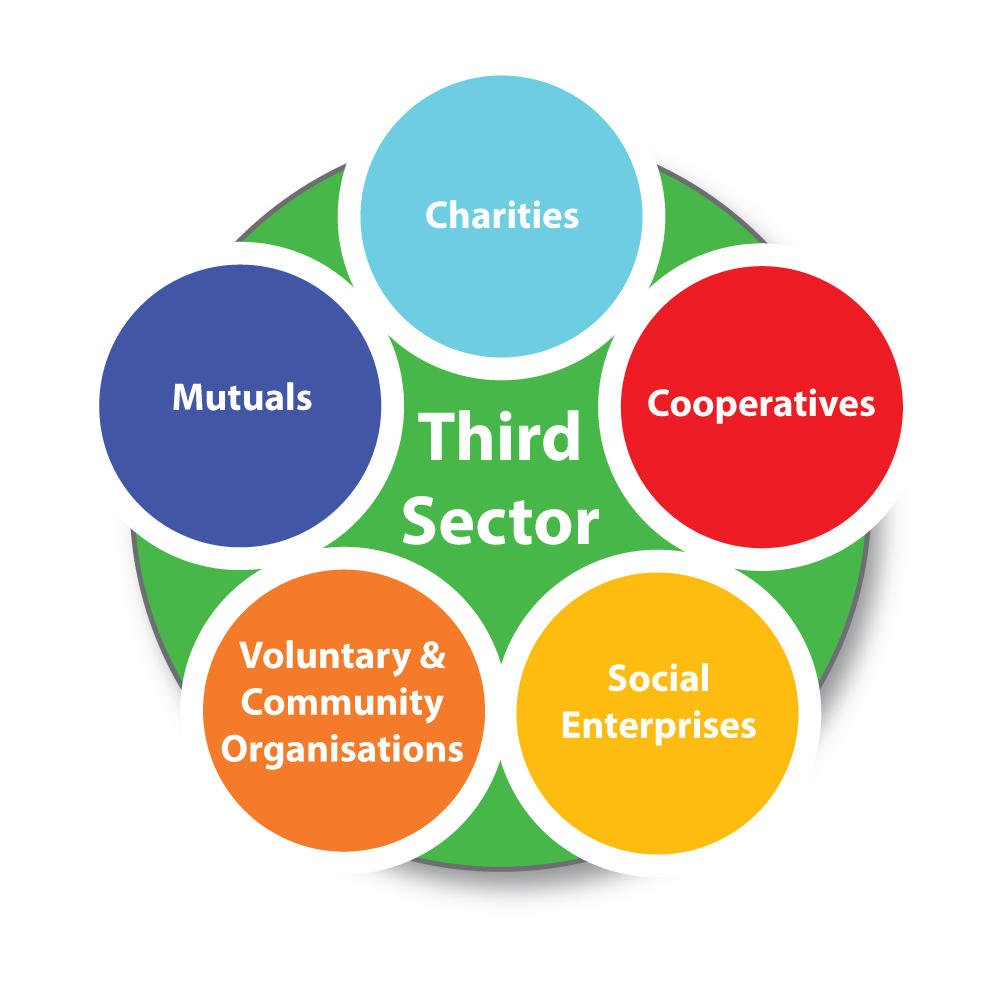
They reinvest surpluses into their mission and may rely on donations, grants, volunteers or trading activities.
Legal Structures in the Private Sector
Private-sector organisations can choose from several legal structures, each offering different advantages and levels of risk.
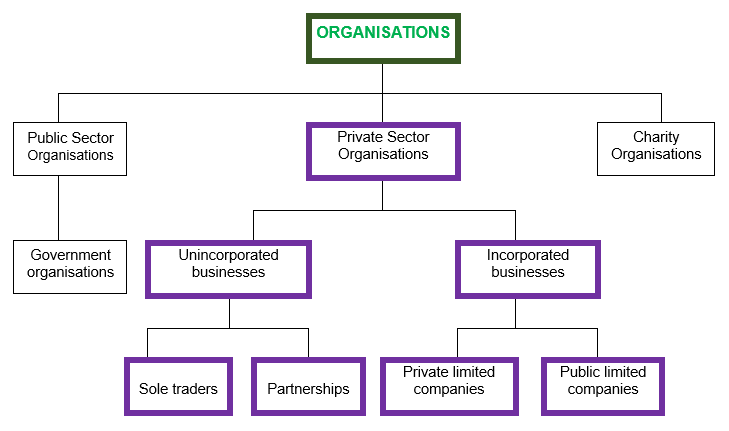
A sole trader is owned by one individual who makes decisions independently and keeps all profits. However, they face unlimited liability, meaning they are personally responsible for debts.
A partnership involves two or more owners who share responsibilities and profits. Skills and resources are combined, but partners may also share personal liability unless operating as a Limited Liability Partnership (LLP).
A private limited company (Ltd) is a separate legal entity. Ownership is divided into shares, and shareholders have limited liability. This structure can attract investment and offers greater protection for owners.
A public limited company (PLC) can sell shares to the public on the stock exchange. PLCs tend to be larger and must publish detailed financial information.
A franchise model allows individuals to operate a business under the brand and systems of an established company. The franchisee benefits from existing brand recognition but must adhere to the franchisor’s rules.
Key Characteristics of Different Types of Organisations
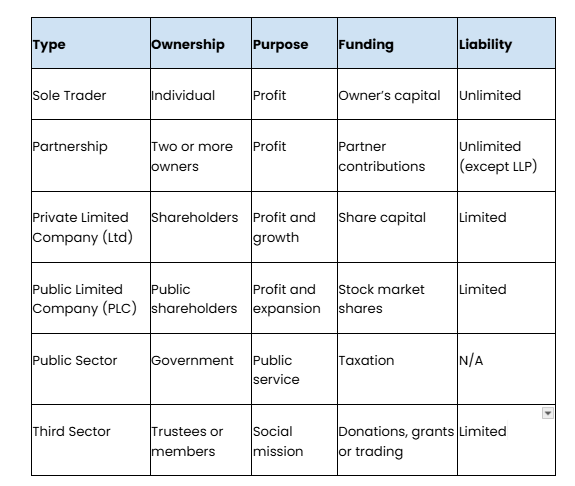
Below is a summary to help compare organisational types:
Interested in our Business Courses?
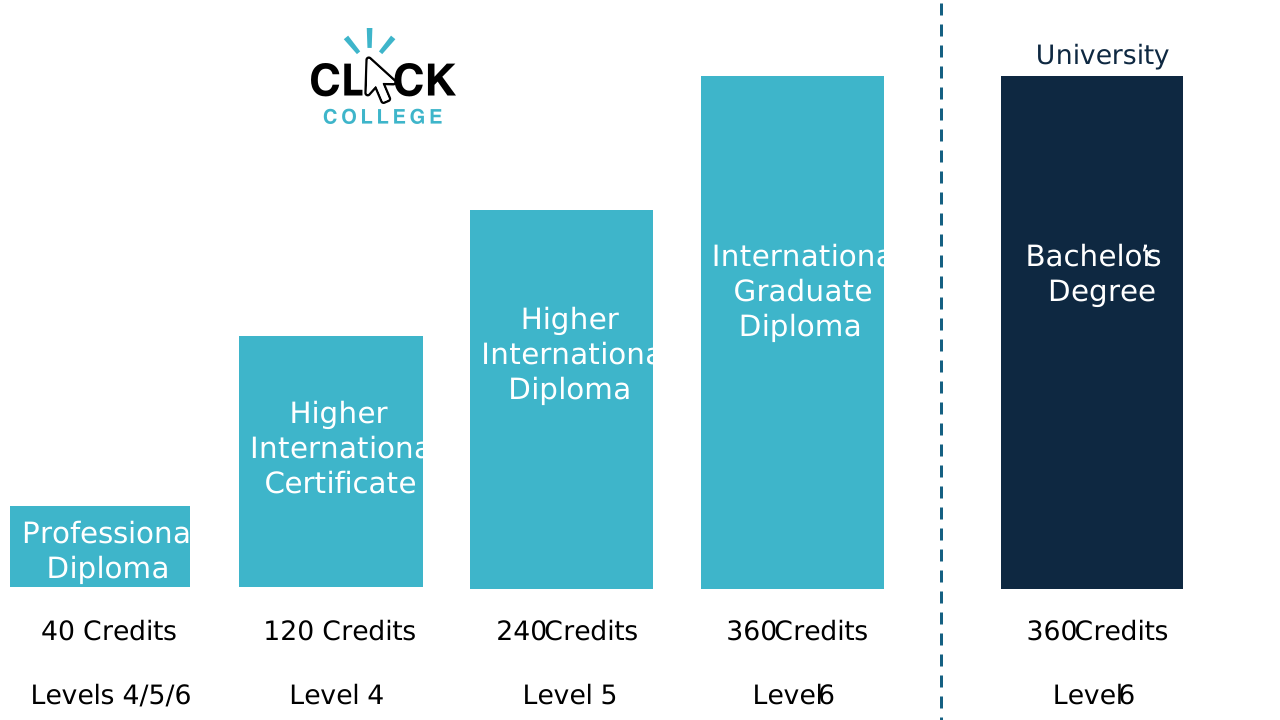
Click College offers a wide range of fully online accredited business management courses and qualifications to suit different academic backgrounds and career goals. Our programmes range from short 40 credit Professional Diplomasthrough to the 360 credit International Graduate Diploma, which is academically comparable to a bachelor’s degree. All courses are open access and available to learners worldwide.
With courses available in business management, marketing, finance, HR, hospitality & tourism and project management, Click College provides flexible learning pathways to support professional development, career progression or further study.
All Courses
Explore our courses and find a qualification that fits your goals and your schedule.
First Year of Undergraduate (Level 4 – 120 Credits)
The Higher International Certificate courses are accredited and delivered at Level 4 of the UK FHEQ framework, making them academically comparable to the first year of undergraduate study.
Years One and Two of Undergraduate (Level 5 – 240 Credits)
The Higher International Diploma courses are accredited and available with 240 Credits at Level 5 of the UK FHEQ framework, making it academically comparable to a Foundation Degree (UK) or an Associate Degree (US).
Degree-Comparable International Graduate Diploma (Level 6 – 360 Credits)
The International Graduate Diploma is accredited and delivered at Level 6 of the UK FHEQ framework. With 360 credits, it is academically comparable to a UK bachelor’s degree in terms of level and credit value.





Recent Posts
Professional Diploma or Higher Qualification Pathway: Which Should You Choose?
Professional Diploma or Higher Qualification Pathway: Which Should You Choose? Choosing the right online qualification is not always simply a question of choosing the longest course or the highest level. For many learners, the better question is: what kind of study route fits my goals right now? Some learners want a focused qualification in one […]
Professional Diploma in Leadership and Management: Course Guide
Professional Diploma in Leadership and Management: Course Guide A Professional Diploma in Leadership and Management is designed for learners who want to develop advanced leadership, strategic thinking and organisational management skills without committing immediately to a full degree programme. Leadership and management are essential in almost every sector. Whether you work in business, education, hospitality, […]
Professional Diploma in Business Management: Who Is It For?
Professional Diploma in Business Management: Who Is It For? A Professional Diploma in Business Management is designed for learners who want to build practical business knowledge without committing immediately to a full degree or long higher education programme. It can be a useful option for people who want to understand how organisations work, how teams […]