Who’s Really in Control? How Organisational Type Shapes Decision-Making
Introduction
Organisations do not simply choose how they are governed or what they prioritise; these elements are largely shaped by organisational type. Whether an organisation operates in the private, public or third sector determines who owns it, how power is distributed, and what outcomes are considered successful. This analysis explores how ownership, governance and priorities interact, and why these relationships produce fundamentally different organisational behaviours across sectors.
Ownership as a Determining Structural Force
Ownership is not only about legal control, it defines whose interests dominate decision-making. Each organisational type embeds a different set of interests into its structure, which then constrains or enables certain strategic choices.
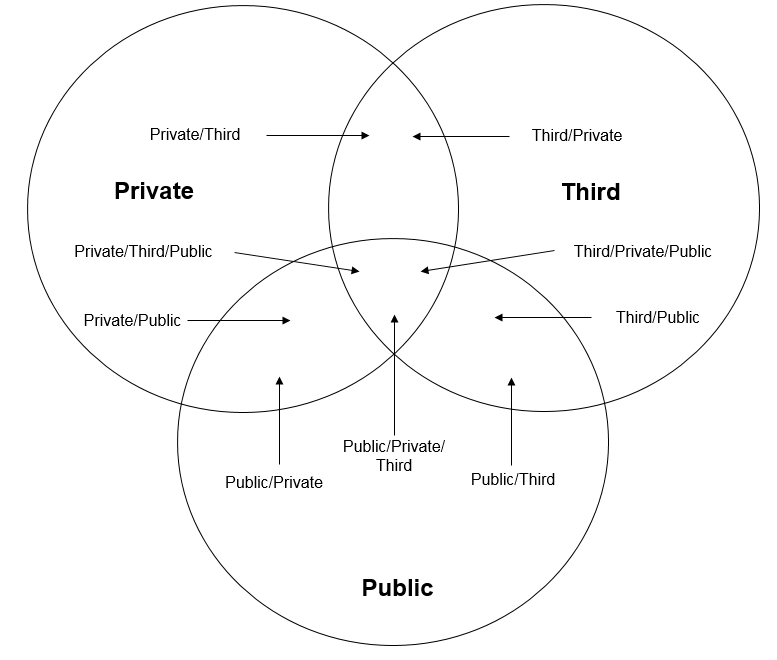
In the private sector, ownership is directly linked to capital investment. Owners or shareholders bear financial risk, which creates a strong incentive for returns. This results in a governance environment where success is measured predominantly through financial performance. Even where ethical or social goals exist, they are often secondary unless they contribute to long-term profitability. Ownership therefore creates a pressure for efficiency, innovation and competitiveness, but may also encourage short-term decision-making if shareholder expectations dominate.
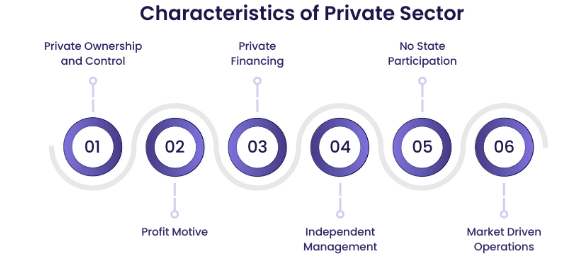
In contrast, public-sector organisations lack private owners, which fundamentally alters accountability. Ownership is collective and indirect, exercised through elected representatives. This weakens the link between performance and reward, meaning priorities are shaped less by financial outcomes and more by political legitimacy and public trust. While this can promote fairness and universal access, it may also reduce incentives for efficiency, as financial loss does not threaten organisational survival in the same way it does in the private sector.

The third sector occupies a hybrid position. Ownership is usually vested in trustees or members, but they do not personally benefit from surplus generation. This protects the organisation’s mission but can limit access to capital and restrict growth. Ownership here functions as a safeguarding mechanism rather than a profit-seeking one, reinforcing long-term social objectives while potentially reducing financial flexibility.
Analytical Comparison of Ownership
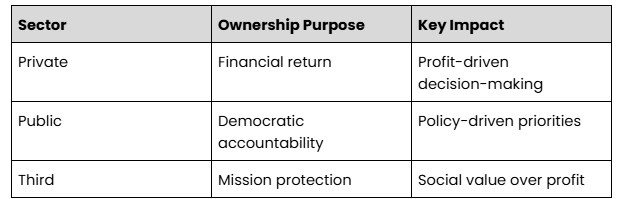
Ownership therefore acts as a structural constraint, shaping what the organisation can realistically prioritise.
Governance as a Reflection of Ownership
Governance structures emerge as a direct response to ownership arrangements. They determine how authority is exercised and how leaders are held accountable.
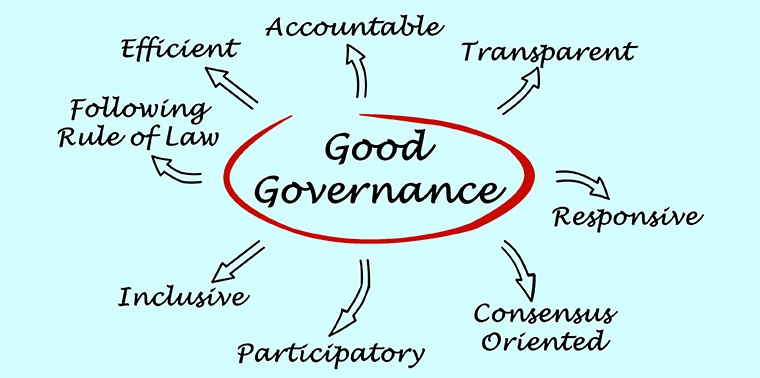
In the private sector, governance is designed to align managerial decisions with shareholder interests. Boards of directors act as agents of owners, and mechanisms such as financial reporting and performance incentives reinforce this alignment. While this creates clarity and accountability, it can also narrow decision-making, particularly when social or environmental concerns conflict with profit goals.
Public-sector governance is inherently multi-layered and politicised. Leaders are accountable to ministers, regulators and the public, which can slow decision-making and dilute responsibility. However, this complexity exists to prevent misuse of public funds and to ensure transparency. Governance in this sector prioritises compliance and legitimacy over speed or innovation, which can be both a strength and a limitation.
Third-sector governance places trustees at the centre of decision-making, creating a values-based model of oversight. Trustees are legally required to act in the best interests of beneficiaries, which strengthens ethical accountability. However, reliance on voluntary governance can sometimes limit expertise or strategic capacity, particularly in smaller organisations.
- Private sector: High efficiency, narrow accountability
- Public sector: High transparency, lower flexibility
- Third sector: High ethical focus, variable capacity
Governance structures therefore reflect not only ownership but also the risks each sector is designed to manage.
Priority Setting and Organisational Behaviour
Priorities represent the practical outcome of ownership and governance arrangements. They determine how resources are allocated and how success is evaluated.
Private-sector organisations prioritise financial sustainability and competitive advantage, as failure directly threatens survival. This drives innovation and responsiveness but may marginalise non-financial stakeholders.
Public-sector organisations prioritise equity, access and social stability. Their performance is judged on service quality rather than profit, which allows them to support vulnerable groups. However, limited budgets and political constraints can restrict responsiveness and innovation.
Third-sector organisations prioritise mission fulfilment, often accepting financial insecurity to maintain ethical integrity. While this creates strong stakeholder trust, it can also result in dependence on grants or donations, increasing vulnerability to external funding changes.
Interdependence of Ownership, Governance and Priorities
These three elements form a reinforcing system rather than independent components. Ownership establishes authority, governance formalises decision-making, and priorities define outcomes.
For example:
- In a private company, shareholder ownership leads to governance systems focused on performance, which reinforces profit-driven priorities.
- In a charity, trustee oversight reinforces mission alignment, which maintains a focus on social outcomes.
- In public organisations, democratic ownership leads to bureaucratic governance, reinforcing public accountability and fairness.
This interdependence explains why transferring governance models between sectors often fails. A private-sector performance model applied to public services may undermine equity, while public-sector controls imposed on charities may restrict agility.
Case Study: Consider a public hospital, a private hospital and a health-focused charity.

The public hospital is government-funded and accountable to regulators and the public. Its priorities include safety, access, service quality and adherence to national health standards. Governance is influenced by political decision-making, and financial surplus is reinvested into public services.
A private hospital is owned by shareholders. Its governance focuses on efficiency, competitiveness and customer satisfaction for paying clients. Financial performance is essential, and decisions aim to strengthen profitability, brand reputation and patient experience.
A health charity is governed by trustees and funded by donations. Its priority is social impact, such as improving community wellbeing or disease prevention. Governance is mission-centred, and decisions aim to maximise benefit to beneficiaries rather than generate revenue.
The three organisations operate in the same sector but have entirely different governance systems, ownership models and strategic priorities because their organisational types are fundamentally different.
Interested in our Business Courses?
Click College offers a wide range of fully online accredited business management courses and qualifications to suit different academic backgrounds and career goals. Our programmes range from short 40 credit Professional Diplomasthrough to the 360 credit International Graduate Diploma, which is academically comparable to a bachelor’s degree. All courses are open access and available to learners worldwide.
With courses available in business management, marketing, finance, HR, hospitality & tourism and project management, Click College provides flexible learning pathways to support professional development, career progression or further study.
All Courses
Explore our courses and find a qualification that fits your goals and your schedule.
First Year of Undergraduate (Level 4 – 120 Credits)
The Higher International Certificate courses are accredited and delivered at Level 4 of the UK FHEQ framework, making them academically comparable to the first year of undergraduate study.
Years One and Two of Undergraduate (Level 5 – 240 Credits)
The Higher International Diploma courses are accredited and available with 240 Credits at Level 5 of the UK FHEQ framework, making it academically comparable to a Foundation Degree (UK) or an Associate Degree (US).
Degree-Comparable International Graduate Diploma (Level 6 – 360 Credits)
The International Graduate Diploma is accredited and delivered at Level 6 of the UK FHEQ framework. With 360 credits, it is academically comparable to a UK bachelor’s degree in terms of level and credit value.







Recent Posts
Professional Diploma or Higher Qualification Pathway: Which Should You Choose?
Professional Diploma or Higher Qualification Pathway: Which Should You Choose? Choosing the right online qualification is not always simply a question of choosing the longest course or the highest level. For many learners, the better question is: what kind of study route fits my goals right now? Some learners want a focused qualification in one […]
Professional Diploma in Leadership and Management: Course Guide
Professional Diploma in Leadership and Management: Course Guide A Professional Diploma in Leadership and Management is designed for learners who want to develop advanced leadership, strategic thinking and organisational management skills without committing immediately to a full degree programme. Leadership and management are essential in almost every sector. Whether you work in business, education, hospitality, […]
Professional Diploma in Business Management: Who Is It For?
Professional Diploma in Business Management: Who Is It For? A Professional Diploma in Business Management is designed for learners who want to build practical business knowledge without committing immediately to a full degree or long higher education programme. It can be a useful option for people who want to understand how organisations work, how teams […]