Why Every Business Must Understand the Law (Even If It Doesn’t Feel Legal)
Running a business isn’t just about products, profits and customers. Behind every successful organisation sits something far less glamorous but incredibly powerful: the law.
From how employees are hired to how customer data is handled, legal frameworks quietly shape almost every decision a business makes. These rules aren’t designed to make life difficult for organisations. Instead, they exist to create fairness, protect people and ensure businesses operate responsibly within society.
For leaders and managers, understanding the legal environment isn’t optional. It’s a fundamental part of running a stable, ethical and successful organisation.
Let’s explore how law influences the way businesses actually operate.
The Hidden Legal Framework Behind Everyday Business Decisions
Most people think of legal issues as something that only arises when something goes wrong. In reality, legal frameworks shape everyday operations.
They influence:
- how employees are recruited and managed
- how products are designed and marketed
- how organisations store customer information
- how workplaces keep people safe
- how companies compete in the marketplace
When organisations fail to comply with these frameworks, the consequences can be severe. Businesses may face fines, investigations, reputational damage or even criminal liability.
This is why well-run organisations embed legal compliance into policies, procedures and organisational culture.
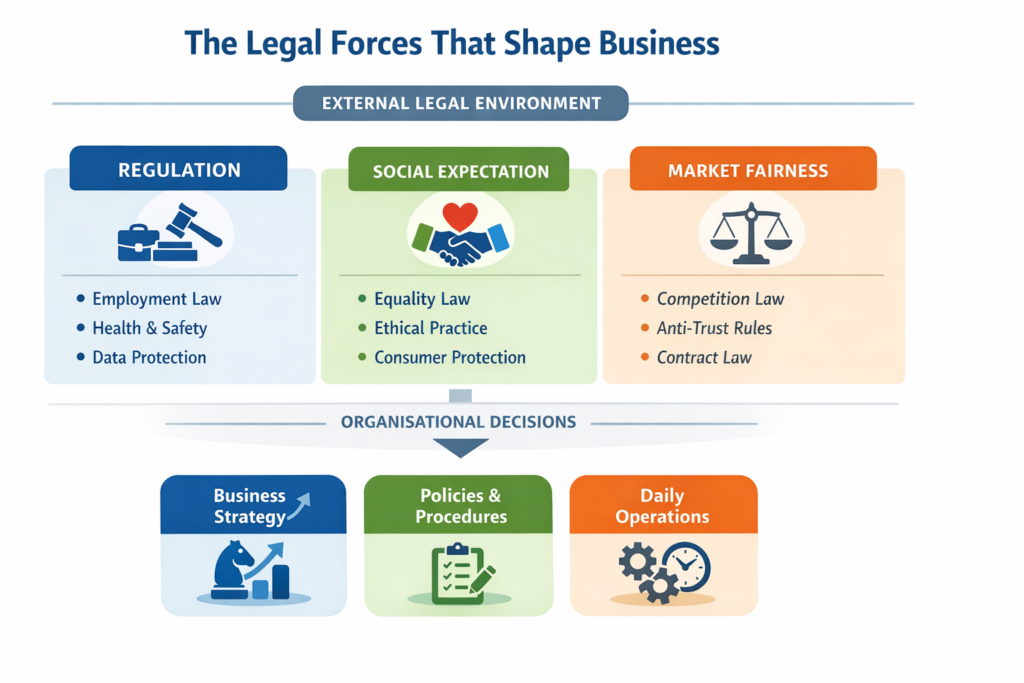
Employment Law: Protecting the Workforce
One of the most significant areas of law affecting organisations is employment law.
These rules regulate the entire employment relationship, from recruitment to dismissal. They set out standards for working hours, pay, rest breaks, holidays and notice periods, while also protecting employees from unfair treatment.
For managers, employment law influences decisions such as:
- how jobs are advertised
- how interviews are conducted
- how contracts are written
- how disciplinary issues are handled
When organisations understand these rules, they create workplaces that are fairer, more stable and less vulnerable to disputes.
Equality Law: Building Fair and Inclusive Workplaces
Closely connected to employment law are equality and anti-discrimination frameworks.
These laws protect individuals from discrimination based on characteristics such as age, disability, race, religion, gender or sexual orientation. They influence recruitment decisions, promotion opportunities and workplace policies.
In practice, equality legislation encourages organisations to create environments where people are treated fairly and opportunities are based on ability rather than bias.
For businesses, this is not just about compliance. Inclusive workplaces often benefit from stronger collaboration, better innovation and higher employee engagement.
Consumer Protection: Earning Customer Trust
Businesses also operate within legal frameworks designed to protect consumers.
Consumer protection laws ensure that products and services are:
- safe
- accurately described
- fit for purpose
Customers also have rights regarding refunds, warranties and compensation if something goes wrong.
For organisations, this means product design, marketing, packaging and customer service must all operate within legal boundaries. If a product turns out to be unsafe, a company may even need to issue a product recall.
While this may seem restrictive, consumer protection laws ultimately build trust between businesses and customers.
Data Protection: Safeguarding Personal Information
Modern organisations collect vast amounts of personal data.
This may include employee records, customer details, payment information or marketing data. Laws such as data protection and privacy regulations require organisations to handle this information responsibly.
Businesses must ensure that personal data is:
- stored securely
- used for legitimate purposes
- kept accurate
- retained only when necessary
Failure to protect personal information can lead to serious financial penalties and reputational damage. Strong data governance is therefore essential in today’s digital economy.
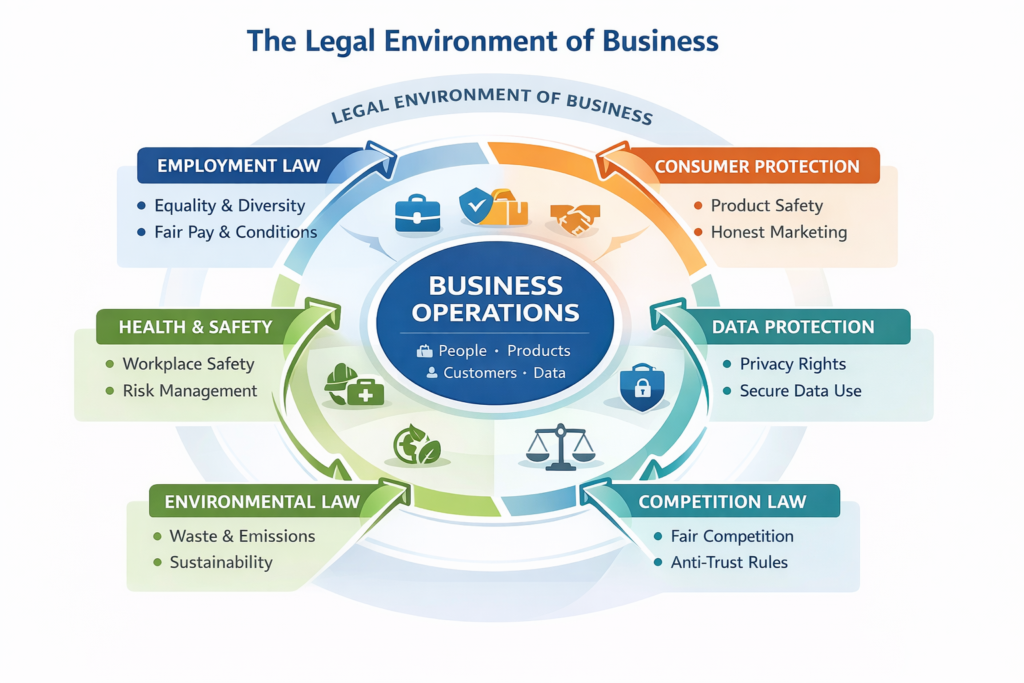
Health and Safety: Protecting People at Work
Health and safety legislation places a legal duty on organisations to protect employees and anyone affected by their activities.
This means businesses must:
- assess workplace risks
- provide appropriate training
- maintain equipment safely
- investigate accidents
- implement safe systems of work
Health and safety frameworks influence everything from workplace design to shift scheduling. Organisations that take safety seriously not only avoid legal consequences but also benefit from higher morale and fewer operational disruptions.
Environmental Law: Responding to Sustainability Expectations
Businesses today are also expected to operate responsibly in relation to the environment.
Environmental legislation may require organisations to:
- manage waste responsibly
- reduce emissions
- improve energy efficiency
- limit pollution
- report environmental impact
These regulations increasingly shape decisions about supply chains, production processes and resource use. Organisations that invest early in sustainable practices often gain reputational benefits and long-term operational advantages.
Competition Law: Keeping Markets Fair
Competition law ensures that markets remain open and fair.
It prevents organisations from engaging in practices such as:
- price fixing
- market sharing agreements
- abusing a dominant market position
These rules protect consumers by ensuring businesses compete honestly and innovation continues.
For organisations, this means commercial decisions around pricing, partnerships and mergers must always consider competition regulations.
Why Legal Awareness Matters in Modern Organisations
Legal frameworks rarely operate in isolation. In reality, they overlap and interact.
For example:
- product design may involve consumer protection, environmental regulation and intellectual property law
- marketing campaigns must consider data protection and advertising standards
- recruitment decisions must comply with employment law and equality legislation
Because of this complexity, successful organisations do not treat legal compliance as an afterthought. Instead, they integrate legal awareness into everyday decision-making.
When businesses understand the legal environment, they are better equipped to operate safely, ethically and sustainably.
And ultimately, that’s what allows organisations to build trust — with employees, customers, regulators and society as a whole.
Interested in our Business Courses?
Click College offers a wide range of fully online accredited business management courses and qualifications to suit different academic backgrounds and career goals. Our programmes range from short 40 credit Professional Diplomasthrough to the 360 credit International Graduate Diploma, which is academically comparable to a bachelor’s degree. All courses are open access and available to learners worldwide.
With courses available in business management, marketing, finance, HR, hospitality & tourism and project management, Click College provides flexible learning pathways to support professional development, career progression or further study.
All Courses
Explore our courses and find a qualification that fits your goals and your schedule.
First Year of Undergraduate (Level 4 – 120 Credits)
The Higher International Certificate courses are accredited and delivered at Level 4 of the UK FHEQ framework, making them academically comparable to the first year of undergraduate study.
Years One and Two of Undergraduate (Level 5 – 240 Credits)
The Higher International Diploma courses are accredited and available with 240 Credits at Level 5 of the UK FHEQ framework, making it academically comparable to a Foundation Degree (UK) or an Associate Degree (US).
Degree-Comparable International Graduate Diploma (Level 6 – 360 Credits)
The International Graduate Diploma is accredited and delivered at Level 6 of the UK FHEQ framework. With 360 credits, it is academically comparable to a UK bachelor’s degree in terms of level and credits.






Recent Posts
Professional Diploma or Higher Qualification Pathway: Which Should You Choose?
Professional Diploma or Higher Qualification Pathway: Which Should You Choose? Choosing the right online qualification is not always simply a question of choosing the longest course or the highest level. For many learners, the better question is: what kind of study route fits my goals right now? Some learners want a focused qualification in one […]
Professional Diploma in Leadership and Management: Course Guide
Professional Diploma in Leadership and Management: Course Guide A Professional Diploma in Leadership and Management is designed for learners who want to develop advanced leadership, strategic thinking and organisational management skills without committing immediately to a full degree programme. Leadership and management are essential in almost every sector. Whether you work in business, education, hospitality, […]
Professional Diploma in Business Management: Who Is It For?
Professional Diploma in Business Management: Who Is It For? A Professional Diploma in Business Management is designed for learners who want to build practical business knowledge without committing immediately to a full degree or long higher education programme. It can be a useful option for people who want to understand how organisations work, how teams […]