Hospitality Operations Management: A Complete Guide for Students and Future Managers
Introduction
If you’ve ever stayed in a hotel, eaten in a busy restaurant, or visited a popular attraction, you’ve already experienced hospitality operations in action — even if you didn’t realise it at the time.
Behind every smooth check-in, well-timed meal or organised customer experience is a carefully managed system of people, processes and decisions. This is what hospitality operations management is all about. It ensures that businesses run efficiently while delivering a consistent, high-quality experience to customers.
For students considering a career in hospitality or business management, understanding operations is essential. It provides a clear view of how real organisations function and how successful businesses balance customer satisfaction with profitability.
What is hospitality operations management?
Hospitality operations management refers to the planning, coordination and control of daily activities within hospitality and service businesses. This includes everything from managing staff and customer service to controlling demand and maintaining quality standards.
Unlike many industries, hospitality operations are highly dynamic. Customer demand can change quickly, services are often delivered in real time, and expectations are constantly evolving. This means managers must be able to respond quickly, make informed decisions and ensure that all parts of the business work together effectively.
In simple terms, operations management is what keeps hospitality businesses running smoothly — even when conditions are unpredictable.
Why operations are central to hospitality success
In hospitality, operations directly shape both the customer experience and the financial performance of a business.
A hotel may have excellent facilities, but if rooms are not ready on time or check-in is slow, customer satisfaction will fall. A restaurant may serve high-quality food, but poor service delivery can still lead to negative reviews. These examples show that success in hospitality is not just about what is offered, but how it is delivered.
At the same time, operations influence costs and efficiency. Staffing levels, pricing strategies and resource management all sit within operational control. Poor planning can lead to wasted resources and lost revenue, while effective operations can improve profitability even during quieter periods.
This balance between service quality and efficiency is what makes hospitality operations management such a critical area of study.
The key areas of hospitality operations
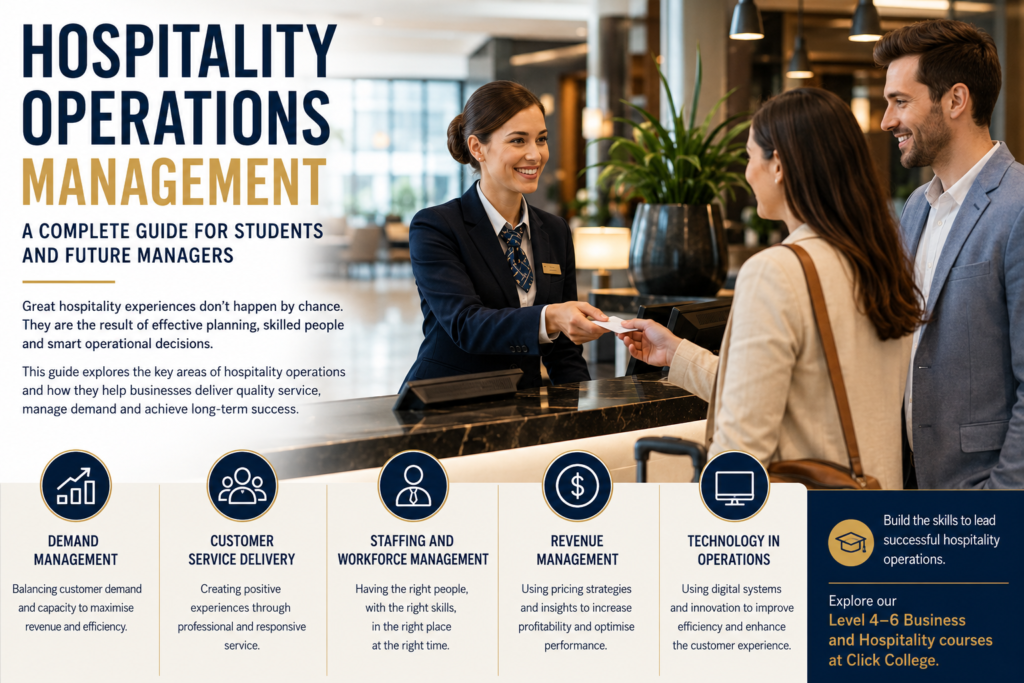
Hospitality operations are made up of several interconnected areas, each playing an important role in how a business performs. Understanding these areas helps students see how different operational decisions come together in practice.
Demand management
One of the biggest challenges in hospitality is that demand is rarely consistent. Businesses often experience busy periods followed by quieter times, influenced by factors such as seasons, weekends, events and travel patterns.
Because hospitality services cannot be stored, unused capacity results in lost revenue. This is why businesses use forecasting, pricing strategies and booking systems to manage when and how customers use their services.
To explore this in more detail, read our guide to demand management in hospitality and how businesses balance demand with capacity.
Customer service delivery
Customer service sits at the centre of hospitality operations because the experience is created in real time. Customers often interact directly with staff, meaning that communication, responsiveness and professionalism all shape how the service is perceived.
Even when operations are efficient, poor service delivery can reduce overall satisfaction. This is why businesses focus heavily on training, service standards and consistency.
You can learn more about this in our article on customer service delivery in hospitality and how great experiences are created.
Staffing and workforce management
Hospitality is a labour-intensive industry, which means staff are a key part of operational success. Businesses must ensure they have the right number of employees, with the right skills, at the right time.
Because demand changes frequently, staffing must remain flexible. This often includes shift patterns, part-time roles and seasonal employment. At the same time, service standards must be maintained, even during busy periods.
Our guide to staffing in hospitality and managing people in a high-demand service industry explores how businesses achieve this balance.
Revenue management
Revenue management focuses on maximising income from available capacity. This involves adjusting prices based on demand, analysing booking patterns and encouraging customers to choose different times or services.
It is closely linked to demand management and plays a key role in improving financial performance. Businesses that manage revenue effectively can increase profitability without necessarily increasing capacity.
To understand this further, read about revenue management in hospitality and the pricing strategies that drive profitability.
Technology in hospitality operations
Technology is increasingly shaping how hospitality businesses operate. Online booking systems, mobile check-in, digital menus and automated processes have improved efficiency and convenience for both customers and staff.
However, technology must be balanced with personal service. While customers value speed and convenience, they still expect human interaction and support when it matters.
Our article on technology in hospitality operations and how digital systems are transforming service explores this balance in more detail.
Managing operations during busy periods
One of the most challenging aspects of hospitality operations is dealing with peak demand. During busy periods, businesses must serve more customers while maintaining the same level of service quality.
This requires careful planning and coordination across all departments. Staff must communicate effectively, workflows must be efficient and managers must ensure that resources are used appropriately.
For example, a hotel during peak season may experience full occupancy, increased restaurant demand and greater pressure on facilities. Without strong operational control, this can lead to delays, overcrowding and reduced customer satisfaction.
Successful businesses prepare for these situations in advance, using forecasting, staffing adjustments and demand management strategies to maintain consistency.
Why operations matter for your career
For students studying hospitality or business, operations management provides practical, real-world skills that employers value highly.
Understanding how to manage demand, coordinate teams, deliver customer service and improve efficiency prepares you for a wide range of roles across the industry. These skills are transferable and relevant in hotels, restaurants, tourism, events and beyond.
Hospitality operations also develop key professional abilities, including communication, problem-solving, organisation and leadership. These are essential for progressing into management roles.
At Click College, these skills are embedded within our Level 4–6 Business and Hospitality courses, helping students move beyond theory and prepare for real industry environments.
Final thoughts
Hospitality operations management is what brings the industry together. It connects staffing, service delivery, pricing and customer experience into one coordinated system.
Because the industry is fast-moving and customer-focused, operations must be flexible, responsive and well organised. Businesses that manage operations effectively are more likely to deliver consistent service, maintain customer satisfaction and achieve long-term success.
For anyone looking to study and build a career in hospitality, understanding operations is not just useful — it is essential.
View Courses in Hospitality and Tourism…
Start your journey in hospitality and tourism with an accredited Click College course. Enrol today and build the skills, knowledge, and confidence to progress into a management role.







Recent Posts
Professional Diploma or Higher Qualification Pathway: Which Should You Choose?
Professional Diploma or Higher Qualification Pathway: Which Should You Choose? Choosing the right online qualification is not always simply a question of choosing the longest course or the highest level. For many learners, the better question is: what kind of study route fits my goals right now? Some learners want a focused qualification in one […]
Professional Diploma in Leadership and Management: Course Guide
Professional Diploma in Leadership and Management: Course Guide A Professional Diploma in Leadership and Management is designed for learners who want to develop advanced leadership, strategic thinking and organisational management skills without committing immediately to a full degree programme. Leadership and management are essential in almost every sector. Whether you work in business, education, hospitality, […]
Professional Diploma in Business Management: Who Is It For?
Professional Diploma in Business Management: Who Is It For? A Professional Diploma in Business Management is designed for learners who want to build practical business knowledge without committing immediately to a full degree or long higher education programme. It can be a useful option for people who want to understand how organisations work, how teams […]