Technology in Hospitality Operations: How Digital Systems Are Transforming Service
Introduction
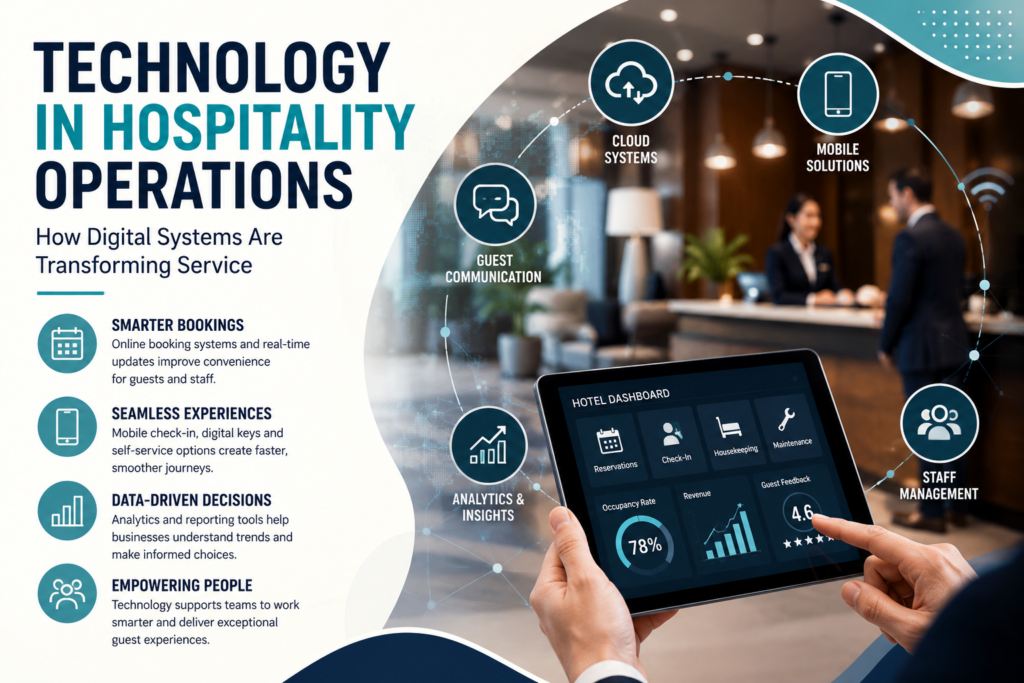
Technology has become one of the biggest forces shaping the modern hospitality industry. From online bookings and mobile check-in to digital menus and automated pricing systems, technology now influences almost every part of hospitality operations.
For customers, these systems often improve speed, convenience and accessibility. For businesses, they create opportunities to improve efficiency, manage resources more effectively and respond more quickly to changing customer expectations.
However, hospitality remains a people-focused industry. While technology can streamline operations, customers still expect personal interaction, reassurance and high-quality service. This means hospitality businesses must find the right balance between automation and human connection.
For students studying hospitality or business management, understanding how technology influences operations is essential because digital systems are now deeply connected to customer service, staffing, demand management and profitability.
Why technology is important in hospitality
Hospitality businesses operate in fast-moving environments where customer expectations continue to rise. Guests increasingly expect services to be quick, simple and available at any time.
Technology helps businesses meet these expectations by improving communication, reducing delays and creating smoother customer experiences. It also allows organisations to collect and analyse data, helping managers make better operational decisions.
At the same time, competition within the hospitality industry is extremely high. Businesses that fail to modernise their systems may struggle to keep up with customer expectations and operational demands.
As a result, technology has become a central part of hospitality operations rather than simply an additional feature.
Online booking systems and digital reservations
One of the clearest examples of technology in hospitality is the use of online booking systems.
Hotels, restaurants and tourism businesses now rely heavily on digital reservations to manage customer demand and improve operational planning. Customers can compare prices, view availability and make bookings instantly from their phones or computers.
For businesses, these systems provide valuable information about customer behaviour and booking patterns. Managers can monitor occupancy levels, predict demand and allocate resources more effectively.
Digital booking systems also reduce uncertainty. Hotels can prepare rooms in advance, restaurants can organise seating arrangements and attractions can control visitor numbers more efficiently.
This is closely connected to operational planning and customer demand. To explore this further, read our guide to demand management in hospitality and how businesses balance demand with capacity.
Mobile check-in and self-service technology
Many hospitality businesses now use self-service technology to improve efficiency and reduce waiting times.
Hotels increasingly offer mobile check-in, digital room keys and automated kiosks that allow guests to access services quickly without waiting at reception. Airlines use self-service bag drops and boarding systems, while restaurants often provide QR code menus and app-based ordering.
For customers, these systems can create greater convenience and flexibility. For businesses, they reduce pressure on staff and improve operational efficiency during busy periods.
However, not all customers prefer fully automated experiences. Some still value face-to-face interaction and personal assistance, especially when dealing with problems or unfamiliar situations. This means businesses must balance convenience with human support.
Technology and customer service delivery
Although technology improves efficiency, customer service remains one of the most important parts of hospitality operations.
Digital systems cannot fully replace human communication, empathy and problem-solving. In many cases, technology works best when it supports staff rather than replacing them entirely.
For example, online booking systems may simplify reservations, but customers still expect helpful staff if changes or issues arise. Mobile check-in may reduce queues, but guests may still want recommendations, reassurance or personal attention during their stay.
This shows that technology and customer service must work together rather than compete against each other.
You can learn more about this relationship in our article on customer service delivery in hospitality and how great experiences are created.
Data and operational decision-making
One of the biggest advantages of technology is the ability to collect and analyse operational data.
Hospitality businesses now use digital systems to monitor:
- booking trends
- customer preferences
- occupancy rates
- sales performance
- staffing needs
- customer feedback
This information helps managers make more informed decisions. For example, a hotel can use booking data to predict busy periods and adjust staffing levels accordingly. Restaurants can analyse customer ordering patterns to improve menu planning and stock control.
Technology therefore plays an important role in improving both efficiency and profitability.
Revenue management and pricing technology
Modern hospitality businesses often use automated systems to support revenue management.
These systems analyse market demand, competitor pricing and booking trends to recommend pricing changes in real time. Hotels, airlines and travel businesses regularly adjust prices based on this data to maximise revenue.
For example, room prices may increase automatically during periods of high demand or decrease during quieter periods to encourage bookings.
Technology has made revenue management faster and more responsive than ever before. Businesses can now react to changing market conditions almost instantly.
This is closely linked to pricing strategies and operational profitability. Our guide to revenue management in hospitality and pricing strategies that drive profitability explores this topic further.
Technology and staffing in hospitality
Technology has also changed the way hospitality businesses manage staff and operations internally.
Scheduling software helps managers organise shifts more efficiently, while communication platforms allow teams to coordinate more effectively during busy periods. Digital training systems also help businesses maintain service standards and improve staff development.
At the same time, technology can reduce repetitive administrative tasks, allowing employees to focus more on customer interaction and service delivery.
However, technology also creates new challenges. Staff must be trained to use digital systems correctly, and businesses must ensure that technology supports operations rather than complicating them.
This shows that staffing and technology are increasingly connected within modern hospitality management.
The growing role of artificial intelligence
Artificial intelligence (AI) is becoming increasingly important within hospitality operations.
Some businesses now use AI-powered chat systems to answer customer questions, automated recommendation systems to personalise offers and predictive software to forecast demand more accurately.
Hotels may use AI to analyse booking behaviour, while restaurants may use automated systems to improve stock management and reduce waste.
Although AI continues to develop rapidly, hospitality businesses must still maintain a strong human element. Customers may appreciate convenience, but they still value genuine interaction and personalised service.
Challenges of technology in hospitality
While technology offers many advantages, it also creates operational challenges.
Technical problems can disrupt customer experiences quickly. Booking system failures, payment issues or app malfunctions may lead to frustration and service delays. Businesses must therefore ensure that systems are reliable and supported properly.
There is also the challenge of maintaining personal service. Hospitality businesses must avoid becoming overly automated, particularly in environments where customers expect warmth, attention and interaction.
Finally, implementing technology can be expensive. Businesses must invest in software, equipment, maintenance and staff training to ensure systems operate effectively.
Why technology matters for your career
For students studying hospitality or business management, understanding hospitality technology is becoming increasingly important.
Employers now expect hospitality professionals to work confidently with digital systems, data and operational software. Technology skills are valuable across hotels, tourism, restaurants, events and travel businesses.
At the same time, employers still value strong communication and customer service abilities. This means future hospitality professionals must be able to combine technical knowledge with interpersonal skills.
At Click College, these industry-relevant concepts are integrated into our Level 4–6 Business and Hospitality programmes, helping students develop practical knowledge that reflects how the modern hospitality industry operates.
Concluding Remarks
Technology is transforming hospitality operations by improving efficiency, supporting decision-making and creating more convenient customer experiences.
However, hospitality remains a people-focused industry where service quality and human interaction still matter greatly. The most successful businesses are those that use technology to enhance operations without losing the personal element that customers value.
For students entering the hospitality industry, understanding how technology influences operations is essential because digital systems now shape almost every part of the customer experience and business environment.
View Courses in Hospitality and Tourism…
Start your journey in hospitality and tourism with an accredited Click College course. Enrol today and build the skills, knowledge, and confidence to progress into a management role.







Recent Posts
Professional Diploma or Higher Qualification Pathway: Which Should You Choose?
Professional Diploma or Higher Qualification Pathway: Which Should You Choose? Choosing the right online qualification is not always simply a question of choosing the longest course or the highest level. For many learners, the better question is: what kind of study route fits my goals right now? Some learners want a focused qualification in one […]
Professional Diploma in Leadership and Management: Course Guide
Professional Diploma in Leadership and Management: Course Guide A Professional Diploma in Leadership and Management is designed for learners who want to develop advanced leadership, strategic thinking and organisational management skills without committing immediately to a full degree programme. Leadership and management are essential in almost every sector. Whether you work in business, education, hospitality, […]
Professional Diploma in Business Management: Who Is It For?
Professional Diploma in Business Management: Who Is It For? A Professional Diploma in Business Management is designed for learners who want to build practical business knowledge without committing immediately to a full degree or long higher education programme. It can be a useful option for people who want to understand how organisations work, how teams […]