Luxury vs Budget Hotels: How Guest Expectations Differ
A luxury hotel and a budget hotel may both provide a clean room, a safe place to stay and help when something goes wrong. Yet guests do not judge the two experiences in exactly the same way. The difference is not that luxury guests expect quality while budget guests do not. Both expect the hotel to fulfil its promise. What changes is the combination of benefits they believe the price, brand and market position should provide.
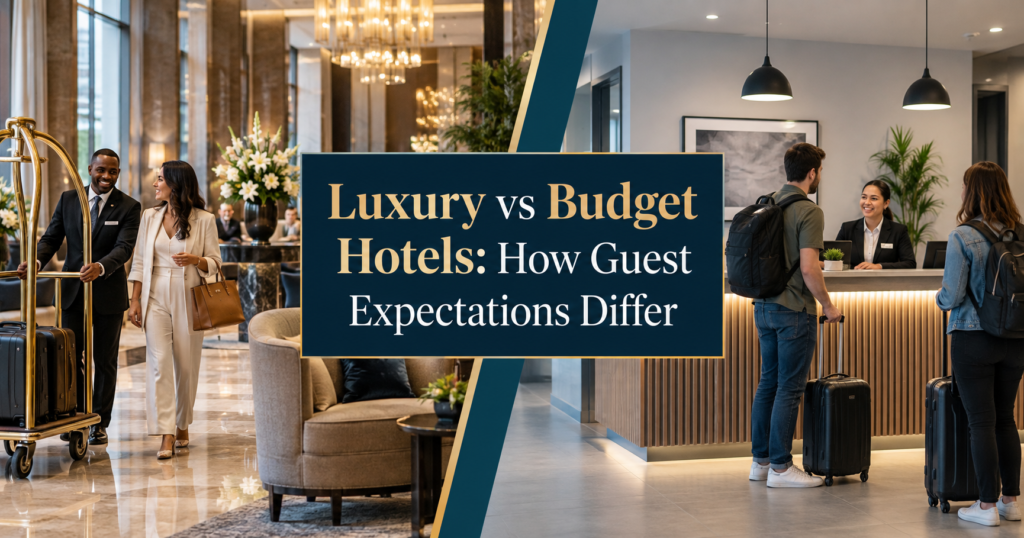
In simple terms, guests at luxury hotels usually expect greater personalisation, comfort, choice and attention to detail. Guests at budget hotels are more likely to prioritise cleanliness, convenience, transparent pricing and reliable essentials. Success in either market depends on understanding that value means delivering the right experience for the chosen guest—not simply adding more features.
What every hotel guest should be able to expect
Some expectations should not depend on room rate. Guests should be able to expect a safe and hygienic environment, accurate booking information, respectful treatment, functioning facilities and a reasonable response when something goes wrong.
Price may change the scale of the room, the range of facilities and the intensity of service, but it should not remove these fundamentals. A budget property can offer limited facilities and still provide excellent hospitality. Equally, expensive surroundings cannot compensate for poor cleanliness, discourteous staff or an unresolved booking problem.
This distinction matters because hotel quality is not measured only by the number of extras available. The AA’s hotel quality standards assess both facilities and service, with progressively higher expectations across different quality levels.[1] VisitEngland likewise describes its quality schemes as an independent assessment of the experience a business offers visitors.[2] These approaches support an important principle: the relevant standard is whether the complete experience matches the hotel’s stated offer and quality position.
Luxury hotel expectations
Luxury guests normally expect the essential service to be delivered with a greater degree of refinement. The room should be comfortable and well maintained, but the expectation often extends to ambience, privacy, premium materials, attractive public spaces and thoughtful details throughout the stay.
Personal recognition and anticipation
Personalisation is a major part of luxury hospitality. Guests may expect staff to recognise preferences, coordinate requests between departments and offer assistance before it is explicitly requested. This does not mean intrusive attention. Effective luxury service is observant and responsive while respecting the guest’s privacy.
For example, a returning guest’s room preferences might be recorded correctly, a concierge might tailor recommendations to the purpose of the visit, or housekeeping might respond sensitively to the guest’s schedule. The value lies in making the stay feel considered rather than standardised.
Choice and flexibility
Luxury guests frequently expect more choice: room types, dining options, service times, amenities and ways to personalise the stay. They may also expect staff to handle unusual requests or changing plans with discretion and confidence.
Flexibility therefore becomes part of the product. A rigid response can feel inconsistent with a premium promise even when the basic service has technically been supplied.
Attention to detail
At a higher price point, small inconsistencies become more noticeable. A delayed response, a maintenance fault or conflicting information between departments may weaken the impression of control and care. Guests are not merely evaluating isolated features; they are judging whether the experience feels coherent from booking to departure.
This is one reason that customer service delivery in hospitality depends on coordination behind the scenes as well as courteous interaction at the front desk.
Budget hotel expectations
Budget hotel guests often accept a more limited service model in return for a lower price. They may not expect a concierge, several restaurants or extensive leisure facilities. However, limited service is not the same as poor service.
Clean, safe and functional accommodation
Cleanliness and functionality are central to the budget promise. A compact room can provide good value when the bed is comfortable, the bathroom is clean, the temperature can be controlled and the advertised facilities work properly.
Failures in these essentials are particularly damaging because they undermine the reason the guest selected the hotel. Decorative luxury may be optional; a clean room and reliable booking are not.
Speed and simplicity
Many budget guests value an uncomplicated experience. They may prefer quick booking, efficient check-in, clear signs, straightforward Wi-Fi access and an easy departure. Self-service technology can support this model, provided that assistance remains available when a system fails or a customer needs help.
Efficiency should reduce effort rather than transfer every difficulty to the guest. A digital check-in process that is fast and intuitive can create value. One that is confusing and unsupported can make a low-cost service feel careless.
Transparent value
Budget customers are often highly attentive to the final price. Optional extras can be acceptable when they are explained clearly, but unexpected compulsory charges can change the guest’s judgement of value.
UK price-transparency guidance states that invitations to purchase should show the total price, including unavoidable fees, and should not omit mandatory charges revealed later in the transaction.[3] For hotel managers, transparent pricing is therefore both a compliance matter and an important part of trust.
Luxury vs budget hotels: a practical comparison
| Aspect | Typical luxury expectation | Typical budget expectation | Essential in both |
|---|---|---|---|
| Accommodation | Spacious, distinctive and highly finished | Compact, practical and functional | Clean, safe and accurately described |
| Service style | Personalised, anticipatory and discreet | Friendly, efficient and straightforward | Respectful and responsive |
| Facilities | Broad choice of dining, leisure and guest services | A focused range of essential facilities | Advertised facilities should work |
| Check-in | Seamless, flexible and personally supported | Fast, simple and convenient | Accurate booking and help when needed |
| Problem resolution | Immediate ownership with tailored recovery | Prompt, practical resolution | Clear communication and fair treatment |
| Price perception | Premium value justified by detail and experience | Strong value based on reliable essentials | No misleading claims or hidden compulsory charges |
| Consistency | Refined standards across every touchpoint | Dependable delivery of the core promise | The experience should match the brand promise |
These are useful patterns rather than fixed rules. A budget guest may value personal attention, while a luxury guest may prefer minimal interaction and digital independence. Managers should use market knowledge to design the service but still respond to the individual guest.
Why budget does not mean lower customer-service standards
A hotel can reduce cost by limiting room size, simplifying the service model or removing facilities that its target guests do not consider essential. It should not reduce cost through misleading information, poor hygiene or indifferent treatment.
In fact, budget hospitality often demands extremely disciplined operations. Guests expect low prices, but they also expect speed, consistency and cleanliness. Meeting those expectations requires carefully designed processes, effective housekeeping, accurate booking systems and staff who can resolve problems without unnecessary delay.
The difference can be expressed simply:
Luxury hospitality aims to deliver more choice, detail and personalisation. Budget hospitality aims to deliver the essentials with exceptional efficiency and reliability.
Neither approach is automatically better. Each succeeds when it creates value for the guests it intends to serve.
How price and brand promises shape perceived value
Expectations form before arrival. Photographs, reviews, star ratings, location, room descriptions and previous experience all influence what the guest imagines the stay will be like. Price is especially powerful because customers often use it as a signal of the quality and benefits they should receive.
This creates an expectation gap when marketing suggests one experience but operations deliver another. A luxury property may disappoint because its personal service feels generic. A budget property may disappoint because a supposedly simple price becomes complicated by compulsory charges. In both cases, dissatisfaction comes from the distance between the promise and the experience.
The intangible nature of hospitality makes this gap especially important. Guests cannot fully test a stay before purchasing it, so they rely on visible evidence and brand signals. Click College’s guide to intangibility in the hospitality industry explains why trust, reviews and physical cues carry so much weight before the service is consumed.
What happens when the experience misses the promise?
The same failure can produce different reactions in different settings. A short wait at reception might be acceptable at a busy budget property if staff communicate clearly. At a luxury hotel promising seamless, attentive service, the same wait may feel more serious because it contradicts the premium proposition.
Managers should therefore assess complaints in context. The operational question is not only, “Did the hotel provide the room?” It is also, “Did the complete experience meet the reasonable expectations created by the hotel’s price, positioning and communications?”
Effective service recovery should acknowledge the effect on the guest, explain what will happen next and resolve the practical problem. The scale of the response can vary, but fairness, ownership and clear communication matter in every market segment.
A simple expectation-alignment framework for hotel managers
Managers can use the following four-stage framework as an editorial planning tool:
- Define the promise. Identify exactly what the hotel’s price, website, brand and booking description lead guests to expect.
- Protect the essentials. Confirm that safety, cleanliness, respectful treatment, accurate information and functional facilities are consistently delivered.
- Design for the target guest. Invest in the attributes the intended market values most, whether that is personalisation and choice or speed and simplicity.
- Measure the gap. Compare guest feedback with the promise, investigate repeated mismatches and improve the relevant process.
This approach helps avoid two common mistakes: copying luxury features that budget guests do not value, and assuming that a lower price excuses failures in basic quality. It also supports a more precise understanding of service quality in service-based organisations.
Develop hospitality management expertise
Understanding how different hotel markets create value is useful for anyone responsible for guest experience, operations or service strategy. Click College offers several online routes for developing this knowledge:
- The Professional Diploma in Hotel Management is a focused 40-credit route covering hotel management knowledge and practice.
- The Higher International Certificate in Hospitality and Tourism Management provides a broader 120-credit Level 4 foundation.
- The Higher International Diploma in Hospitality and Tourism Management extends study through Level 5, with 240 credits in total.
- The International Graduate Diploma in Hospitality and Tourism Management provides a comprehensive Level 6 route comprising 360 credits in total.
Compare the complete Hospitality and Tourism Management course pathway and select the qualification that best matches your existing experience and professional goals.
Frequently asked questions
Do budget hotel guests expect lower-quality service?
Budget guests normally expect fewer facilities and a simpler service model, but they still expect cleanliness, safety, accurate information, courtesy and reliable delivery. The expected experience is more focused, not careless.
What do guests expect from a luxury hotel?
Luxury hotel guests commonly expect premium comfort, refined surroundings, privacy, personal recognition, flexibility and close attention to detail. The precise expectations depend on the brand promise, purpose of the stay and individual guest.
Is a more expensive hotel always better?
No. A higher price may indicate more space, facilities or personalised service, but guest satisfaction depends on whether the experience justifies the promise and price. A well-run budget hotel can deliver better value for its intended guest than a poorly managed luxury property.
Why do two guests judge the same hotel differently?
Guests arrive with different needs, previous experiences, budgets and reasons for travelling. One may value speed and privacy, while another values conversation and personal assistance. Hospitality managers therefore need consistent standards combined with appropriate flexibility.
How can a hotel manage guest expectations?
A hotel should describe its offer accurately, display the total price clearly, maintain consistent operating standards and communicate promptly when circumstances change. Guest feedback can then be used to identify gaps between the promised and delivered experience.
References
[1] AA Hotel Quality Standards
[2] VisitEngland Quality Assessment Services
[3] Competition and Markets Authority: Providing Clear and Accurate Information About Prices
Build Your Future in Hospitality and Tourism
Understanding customer expectations and perceived service quality is valuable for people who want to manage hotels, restaurants and other customer-facing operations.
Studying hospitality and tourism management courses can help learners develop knowledge of service delivery, operations, customer experience and quality improvement.
| Course | Level | Credits | Focus |
|---|---|---|---|
| Professional Diploma in Hospitality Management | 5 | 40 | A focused route covering hospitality operations and service excellence. |
| Professional Diploma in Hotel Management | 5 | 40 | Applied knowledge for hotel operations and guest-service management. |
| Higher International Certificate in Hospitality & Tourism Management | 4 | 120 | A broad higher-level introduction to hospitality and tourism management. |
| Higher International Diploma in Hospitality & Tourism Management | 4–5 | 240 total | Extended study supporting progression in hospitality and tourism management. |
| International Graduate Diploma in Hospitality & Tourism Management | 4–6 | 360 total | A comprehensive graduate-level pathway across hospitality and tourism management. |
All courses are 100% online and self-paced, with no classes, no fixed schedules, no deadlines and no exams. Assessment is completed through coursework, with tutor support available throughout your studies.
Compare Click College’s Hospitality and Tourism Management courses.
Explore Hospitality Courses
Start your journey in hospitality and tourism with an accredited Click College course. Enrol today and build the skills, knowledge, and confidence to progress into a management role.







Recent Posts
How to Build Trust Before a Customer Buys
How to Build Trust Before a Customer Buys Before a customer buys from an unfamiliar business, they are making more than a price comparison. They are deciding whether the offer is genuine, whether the organisation will deliver what it promises and whether help will be available if something goes wrong. That is why trust is […]
Why Customers Switch: The Trust and Value Signals That Drive Churn
Why Customers Switch: The Trust and Value Signals That Drive Churn Customers rarely switch simply because a competitor is cheaper. They switch when the relationship no longer feels safe, fair or worth the effort. A price rise may trigger the search, but unclear charges, poor support, weak proof and uncertainty about what happens next are […]
How to Find and Fix Friction in the Buying Journey
How to Find and Fix Friction in the Buying Journey Customers rarely decide not to buy for one dramatic reason. More often, small difficulties build up: a confusing product page, unclear pricing, a slow reply, an awkward form, conflicting information or a delivery promise that feels uncertain. Each issue may appear minor in isolation. Together, […]