How Competitive Pressure Shapes Business Decisions
Introduction
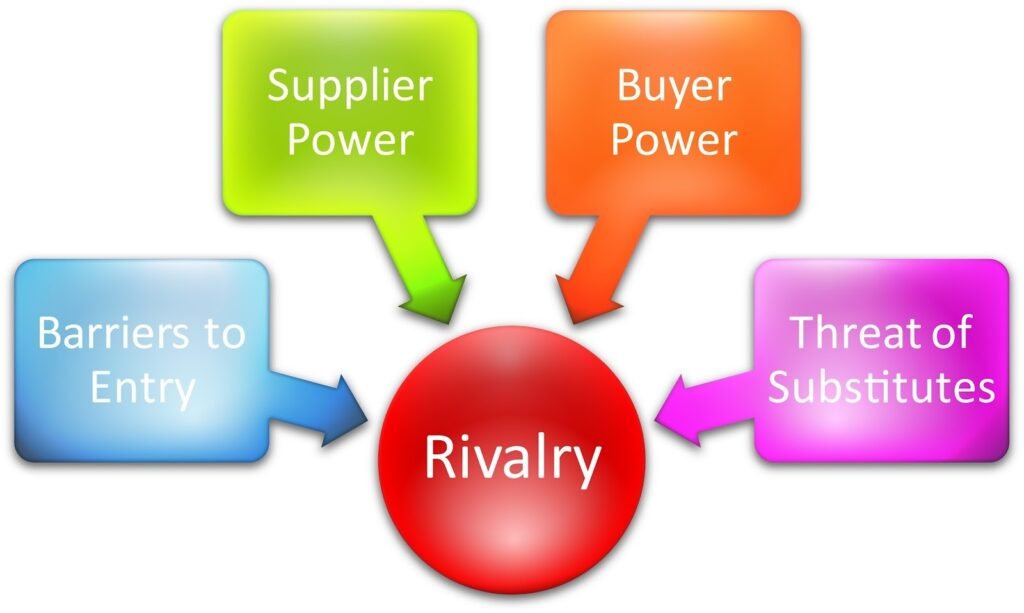
When organisations attempt to understand their competitive environment, they often make the mistake of looking only at their direct rivals, the companies that sell similar products to the same customers. However, in 1979, Michael Porter argued that competition is not merely a contest between rivals but a struggle for profits shaped by a broader set of forces. He introduced the Five Forces Framework, a tool that helps managers analyse the underlying structure of an industry to determine its long-term attractiveness and profitability.
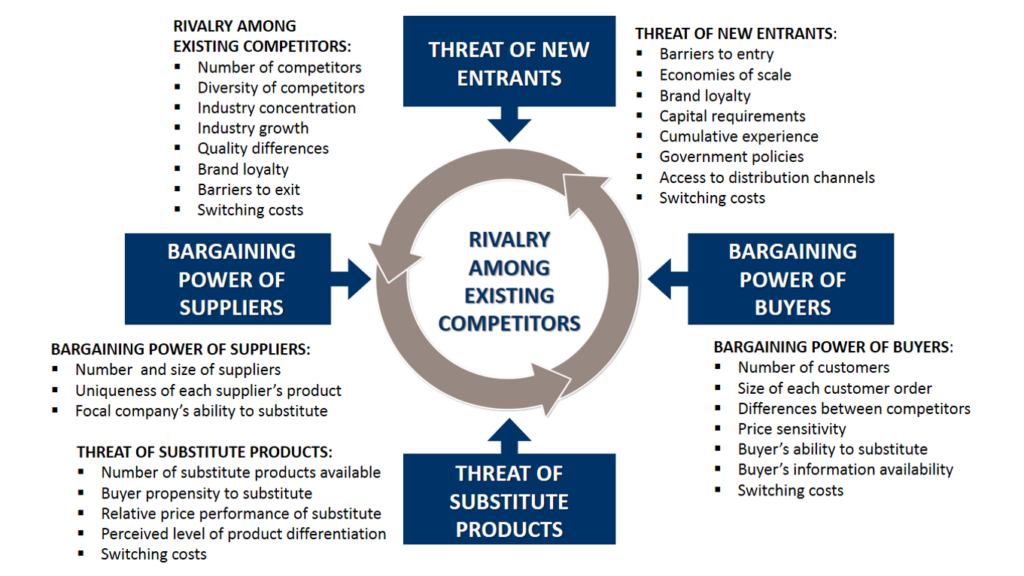
The central premise of this model is that the collective strength of five distinct forces determines the profit potential of an industry. If these forces are intense, as they are in the airline or textile industries, almost no company earns attractive returns on investment. If the forces are benign, as in the software or soft drink industries, many companies are profitable. Understanding these forces allows managers to predict competitor behaviour and position their organisation where it can best defend itself against these pressures.
Rivalry Among Existing Competitors
The first and most visible force is the intensity of rivalry among current competitors in the marketplace. This refers to the struggle for market share between established firms. When rivalry is fierce, organisations are forced to engage in aggressive competitive behaviours such as frequent price discounting, intense advertising campaigns, and rapid service improvements. While these tactics may increase sales volume or customer value, they almost always transfer profits from the industry to the customer, reducing the overall profitability for everyone involved.
Rivalry tends to be most intense when competitors are numerous or roughly equal in size and power, which leads to unstable battles for dominance. It is also heightened when industry growth is slow, forcing firms to fight for market share rather than simply enjoying a growing market. Furthermore, if an industry has high fixed costs or perishable products, managers feel immense pressure to cut prices to fill capacity, triggering price wars. Strategic behaviour in high-rivalry industries therefore focuses heavily on differentiation, trying to create a unique product so that the business does not have to compete solely on price.
The Threat of New Entrants
The second force considers how easy or difficult it is for new companies to enter the industry. New entrants bring new capacity and a hunger for market share, which inevitably puts pressure on prices, costs, and the rate of investment necessary to compete. The strategic significance of this force lies in the concept of barriers to entry. If it is difficult for a new competitor to enter the market, established firms can charge higher prices and earn higher returns without fear of being undercut.
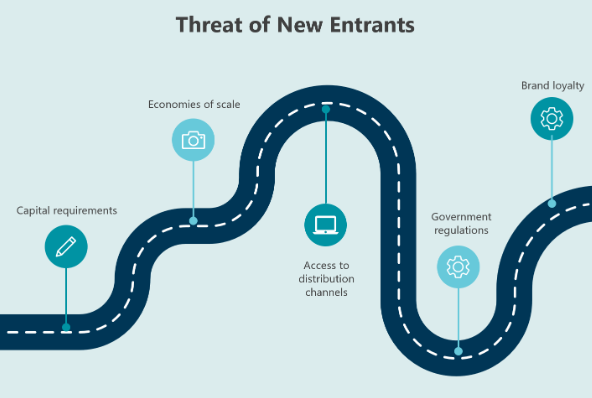
Common barriers that shape organisational behaviour include economies of scale, where existing large firms enjoy lower costs per unit, and high capital requirements, which prevent smaller players from entering industries like aerospace or pharmaceuticals. Managers in established firms often behave strategically to elevate these barriers. For example, they might increase their marketing spend to build insurmountable brand loyalty or lock up distribution channels to ensure new entrants cannot get their products to customers. The mere threat of entry is often enough to force existing companies to keep their prices low and their efficiency high.
The Threat of Substitute Products or Services
A substitute is not a rival product from a direct competitor, but a product from a different industry that meets the same underlying customer need. For example, a video conference call is a substitute for business travel, and a streaming service is a substitute for buying physical DVDs. The threat of substitutes is vital because it places a ceiling on the prices an industry can charge. If an industry raises its prices too high, customers will simply switch to the substitute, causing profits to plummet.
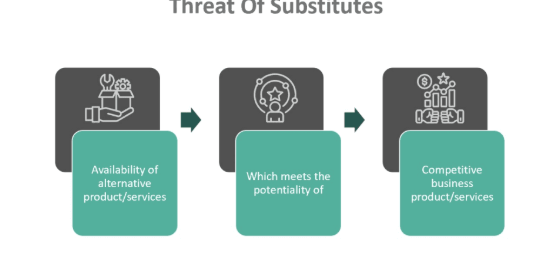
The threat is particularly high when the substitute offers an attractive price-performance trade-off and when the buyer’s cost of switching is low. Organisational behaviour in response to this threat often involves collective industry action or radical innovation. To prevent customers from switching to substitutes, companies must constantly improve the performance and value of their own offering, or attempt to differentiate their product so significantly that the substitute is no longer seen as a viable alternative.
The Bargaining Power of Suppliers
Suppliers can exert significant power over an industry by threatening to raise prices or reduce the quality of purchased goods and services. Powerful suppliers can squeeze profitability out of an industry that is unable to pass on cost increases to its own prices. A supplier group is considered powerful if it is more concentrated than the industry it sells to, meaning there are few suppliers but many buyers.
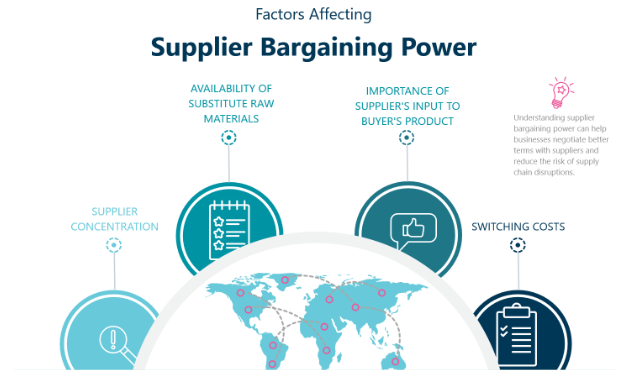
Organisational behaviour changes drastically when suppliers hold the power. Companies may be forced to hold higher levels of inventory to protect against supply disruption, or they may accept lower profit margins to maintain access to essential materials. Strategically, organisations facing powerful suppliers often try to diversify their supply chain so they are not dependent on a single source, or they may threaten “backward integration”—seeking to manufacture the inputs themselves to bypass the supplier entirely.
The Bargaining Power of Buyers
The final force is the power of the customers (buyers). Buyers compete with the industry by forcing down prices, bargaining for higher quality or more services, and playing competitors against each other, all at the expense of industry profitability. Buyers are powerful when they purchase in large volumes relative to the size of a single vendor, or when the products are standard and undifferentiated, meaning they can easily find an alternative supplier.
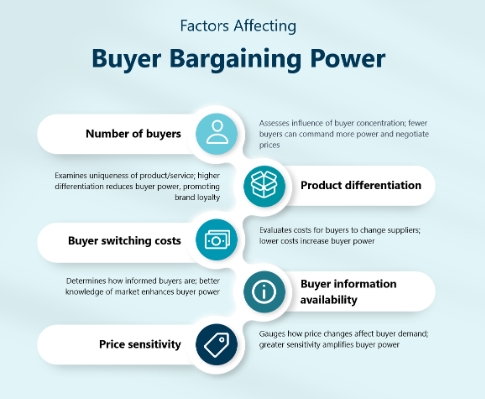
In industries where buyer power is high, such as the grocery sector where supermarkets dictate terms to farmers, supplier behaviour becomes defensive. Organisations must struggle to keep their cost base low enough to be profitable despite the low prices demanded by buyers. Alternatively, they may attempt to reduce buyer power by creating strong brand loyalty or “switching costs” that make it difficult or expensive for the customer to leave.
Interested in our Business Courses?
Click College offers a wide range of fully online accredited business management courses and qualifications to suit different academic backgrounds and career goals. Our programmes range from short 40 credit Professional Diplomasthrough to the 360 credit International Graduate Diploma, which is academically comparable to a bachelor’s degree. All courses are open access and available to learners worldwide.
With courses available in business management, marketing, finance, HR, hospitality & tourism and project management, Click College provides flexible learning pathways to support professional development, career progression or further study.
All Courses
Explore our courses and find a qualification that fits your goals and your schedule.
First Year of Undergraduate (Level 4 – 120 Credits)
The Higher International Certificate courses are accredited and delivered at Level 4 of the UK FHEQ framework, making them academically comparable to the first year of undergraduate study.
Years One and Two of Undergraduate (Level 5 – 240 Credits)
The Higher International Diploma courses are accredited and available with 240 Credits at Level 5 of the UK FHEQ framework, making it academically comparable to a Foundation Degree (UK) or an Associate Degree (US).
Degree-Comparable International Graduate Diploma (Level 6 – 360 Credits)
The International Graduate Diploma is accredited and delivered at Level 6 of the UK FHEQ framework. With 360 credits, it is academically comparable to a UK bachelor’s degree in terms of level and credit val







Recent Posts
Professional Diploma or Higher Qualification Pathway: Which Should You Choose?
Professional Diploma or Higher Qualification Pathway: Which Should You Choose? Choosing the right online qualification is not always simply a question of choosing the longest course or the highest level. For many learners, the better question is: what kind of study route fits my goals right now? Some learners want a focused qualification in one […]
Professional Diploma in Leadership and Management: Course Guide
Professional Diploma in Leadership and Management: Course Guide A Professional Diploma in Leadership and Management is designed for learners who want to develop advanced leadership, strategic thinking and organisational management skills without committing immediately to a full degree programme. Leadership and management are essential in almost every sector. Whether you work in business, education, hospitality, […]
Professional Diploma in Business Management: Who Is It For?
Professional Diploma in Business Management: Who Is It For? A Professional Diploma in Business Management is designed for learners who want to build practical business knowledge without committing immediately to a full degree or long higher education programme. It can be a useful option for people who want to understand how organisations work, how teams […]