Stakeholders Explained: Power, Interest, and Influence
Introduction
Stakeholders are individuals, groups or organisations that have an interest in, or are affected by, the activities, decisions or performance of a business. Every organisation has a wide range of stakeholders, and understanding their needs and expectations is essential to effective management and strategic decision-making. Stakeholders may support or challenge an organisation’s decisions, and their influence can shape the organisation’s direction, priorities and performance.

Internal and External Stakeholders
Stakeholders can be divided into two broad groups: internal stakeholders (those inside the organisation) and external stakeholders (those outside the organisation but still affected by it).
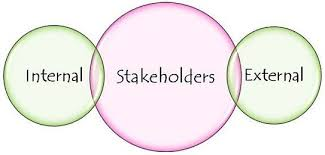
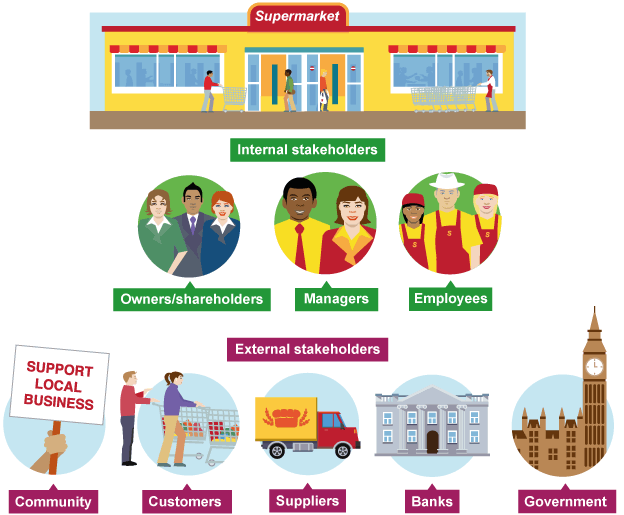
Internal stakeholders typically include:
• Employees
• Managers and supervisors
• Owners or shareholders (in profit-making companies)
• Volunteers (in third-sector organisations)
Internal stakeholders are directly involved in day-to-day operations. They influence organisational performance through their decisions, behaviours and skills.
External stakeholders include a wide range of groups, such as:
• Customers
• Suppliers
• Local communities
• Regulators and government agencies
• Banks and financial institutions
• Competitors
• Pressure groups and advocacy organisations
• Local councils or national government departments
External stakeholders are not part of the organisation but are affected by its decisions. They may have expectations regarding quality, pricing, environmental responsibility, ethical behaviour or service standards.
Differing Interests and Potential Conflicts
Because stakeholders have different priorities, conflicts of interest often arise. Organisations must balance these competing expectations to maintain stability and positive stakeholder relationships.
Examples of differing interests include:
• Employees want fair pay and safe working conditions; owners may want to reduce costs.
• Customers want low prices and high quality; suppliers want higher prices for their goods.
• Local communities may want reduced noise and environmental impact; businesses may want to expand operations.
• Regulators require compliance with laws; managers may prefer flexibility to operate freely.
• Shareholders may want short-term profit; managers may prioritise long-term strategic investment.
These differing interests create situations where organisations must negotiate, prioritise or compromise. Good stakeholder management helps organisations avoid disputes, maintain trust and achieve smoother operations.
Stakeholder Influence
Different stakeholders hold varying levels of influence depending on their power, importance and the organisation’s dependence on them. Stakeholder influence refers to the ability to affect organisational decisions, behaviour or outcomes.
Types of influence include:
• Economic influence: Customers can switch suppliers; investors can withdraw funding; suppliers can change pricing.
• Legislative influence: Government bodies can introduce new regulations or standards.
• Operational influence: Employees influence productivity, service quality and innovation.
• Reputational influence: Media, online reviews and community perceptions can affect the organisation’s image.
• Environmental/social influence: Pressure groups can campaign publicly, influencing policy or public opinion.
Strategic decisions often involve analysing which stakeholders have the greatest influence and ensuring their needs are addressed appropriately.
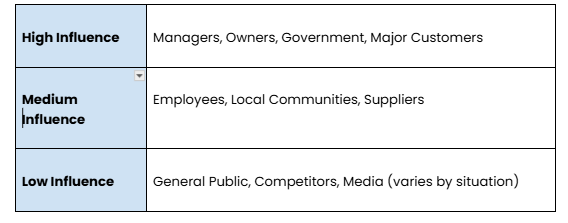
Influence is not fixed, stakeholders may gain or lose influence depending on circumstances. For example, during a labour shortage, employees gain more influence; during financial difficulty, banks gain greater control.
Stakeholder Mapping
Mendelow’s Power–Interest Matrix
Stakeholder mapping is a useful tool that helps organisations identify which stakeholders are most important and how they should be managed. One of the most widely used methods is Mendelow’s Matrix, which categorises stakeholders based on two factors:
• Power (their ability to influence the organisation)
• Interest (their level of concern or involvement)
By plotting stakeholders on a grid, organisations can decide how much attention to give each group and the most appropriate communication approach.
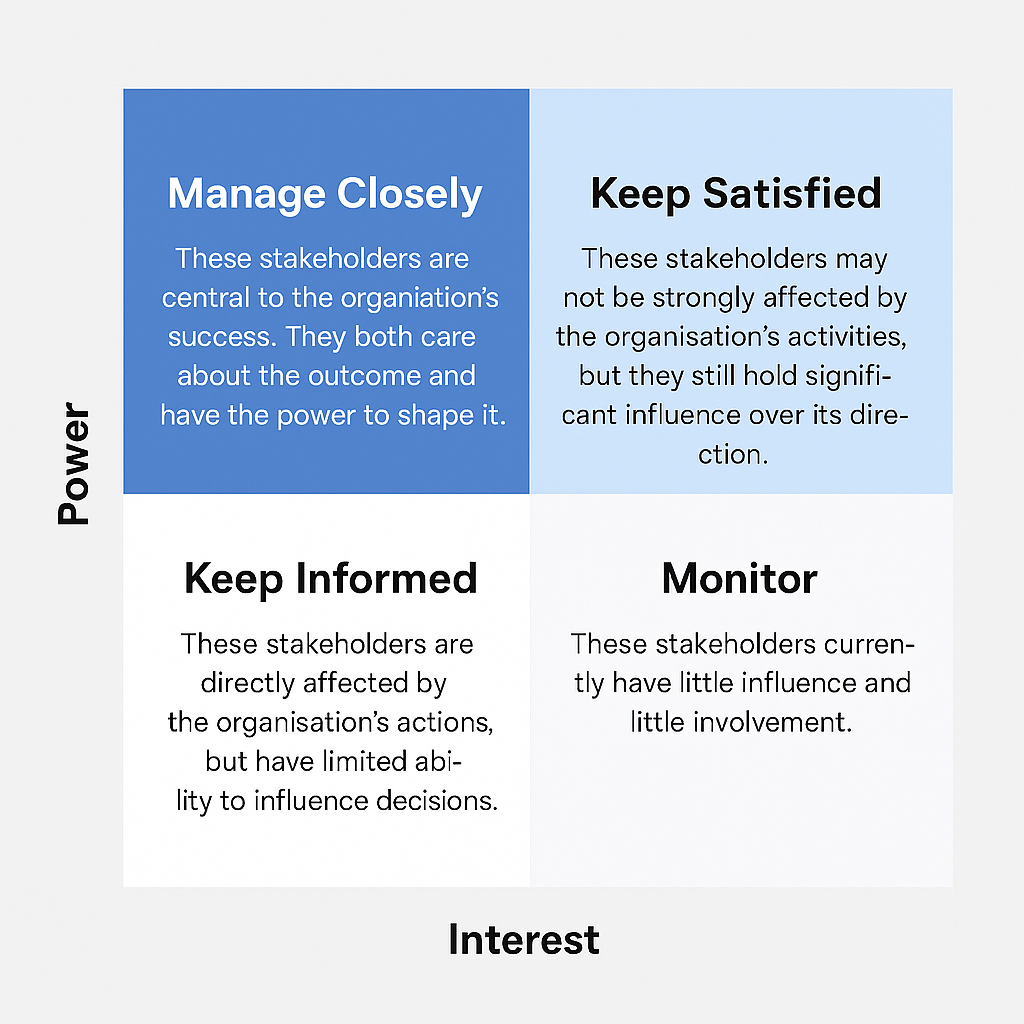
Manage Closely (High Power, High Interest): These stakeholders have both a strong interest in the organisation’s activities and the power to significantly influence decisions. Because of their importance, they should be closely engaged, consulted regularly and involved in key discussions. Meeting their expectations is essential for organisational success.
Keep Satisfied (High Power, Low Interest): These stakeholders hold substantial influence but are not deeply involved in, or affected by, the organisation’s day-to-day activities. They should be kept satisfied through periodic communication and reassurance, without overwhelming them with unnecessary detail. Ensuring their concerns are addressed helps prevent future challenges.
Keep Informed (Low Power, High Interest): These stakeholders are highly interested in the organisation and are affected by its decisions, but they have limited power to influence outcomes. Regular updates, clear communication and opportunities to provide feedback help maintain positive relationships and avoid misunderstandings.
Monitor (Low Power, Low Interest): These stakeholders currently have minimal interest and limited influence. They require basic monitoring rather than active engagement. However, their status can change over time, so it is important to observe any shifts in their level of interest or power.
Mapping stakeholders using Mendelow’s Power Interest Matrix helps organisations understand how best to engage with the individuals and groups who may influence their work. By analysing who holds power and who has a strong interest in organisational activities, leaders can make informed decisions about how to communicate and involve each stakeholder. This process highlights which stakeholders need to be consulted before important decisions are taken, ensuring that their perspectives are considered and that unexpected resistance is avoided.
The mapping exercise also clarifies the level of communication required for different stakeholders. Some groups may need to be closely managed and kept fully informed because their power and interest give them significant influence over outcomes. Others may only require occasional updates or basic information, because their ability to affect decisions is limited. By tailoring communication in this way, organisations can use their time and resources more effectively.
Another important benefit of stakeholder mapping is its ability to help prevent conflict. When organisations anticipate how stakeholders are likely to react to particular decisions or changes, they can take steps to address concerns early, maintain trust and avoid misunderstandings. This contributes to stronger and more stable relationships. In addition, mapping supports better prioritisation of resources by identifying where attention and effort will have the greatest impact.
It is also important to recognise that stakeholder maps are not fixed. Relationships, levels of influence and stakeholder interests can all change over time. For instance, a new regulator may be appointed, a major investor might increase their shareholding or a previously passive stakeholder group may become more active. When such changes occur, stakeholders may move to different positions on the matrix, altering the organisation’s engagement strategy. Regular review of the stakeholder map ensures that the organisation remains aware of these shifts and continues to engage stakeholders appropriately and effectively.
Why Stakeholders Are Important
Stakeholders play a central role in organisational life because they provide the essential resources that enable the organisation to function. Employees contribute their skills, knowledge and labour, which are needed to deliver products and services. Customers provide the revenue on which the organisation depends, and suppliers ensure that materials, technology and expertise are available when required. Investors and financial institutions supply capital, allowing organisations to expand, innovate or manage periods of difficulty. Without the continued support of these stakeholder groups, the organisation would struggle to meet its objectives or maintain its operations.
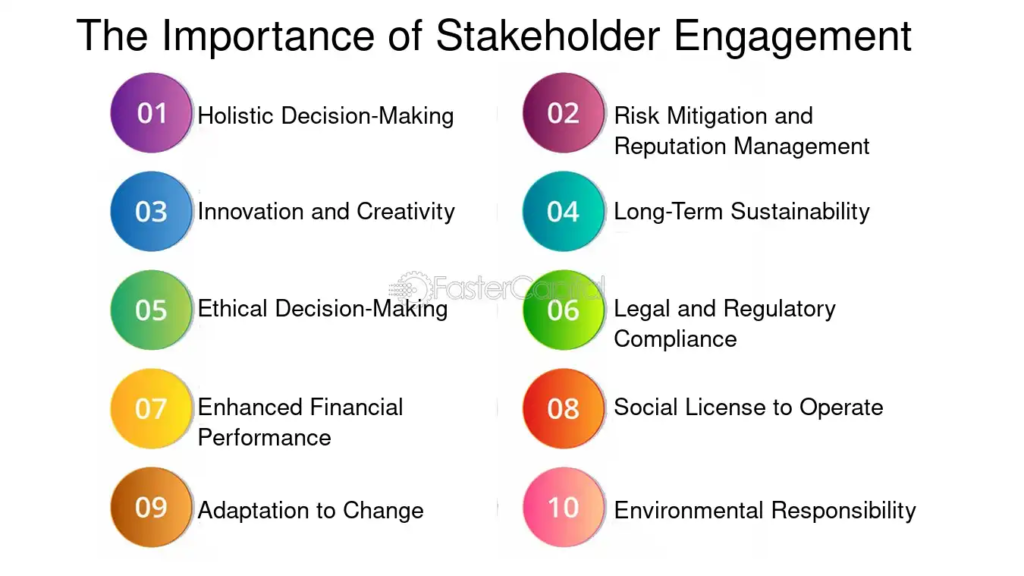
Stakeholders also influence organisational performance. When relationships with stakeholders are positive, organisations benefit from higher levels of trust, cooperation and goodwill. Employees who feel valued and respected are more motivated and productive. Customers who perceive the organisation as trustworthy are more likely to remain loyal and recommend its products or services to others. Investors who have confidence in the organisation are more willing to provide financial backing. Strong stakeholder relationships therefore contribute to overall organisational stability, efficiency and reputation.
Another reason stakeholders are important is their ability to affect organisational risk. When stakeholders become dissatisfied or believe their interests are being overlooked, conflict may arise. Examples include industrial action from employees, customer boycotts, negative media coverage, community opposition or regulatory penalties. These incidents can disrupt operations, damage reputation and lead to financial loss. By understanding stakeholder concerns early and addressing them appropriately, organisations can reduce the likelihood of such risks becoming serious issues.
Stakeholders also help guide the strategic direction of an organisation. Managers who pay attention to stakeholder expectations gain valuable insight into emerging trends, customer preferences, technological developments and social concerns. This information can shape organisational policies, influence product and service design and support the development of long-term plans. For instance, growing interest in sustainable products might encourage an organisation to redesign its processes or supply chain. In this way, stakeholders act as an important source of intelligence that helps organisations adapt to a changing environment.
Finally, effective stakeholder management supports sustainability and long-term growth. Organisations that maintain open communication, build trust and demonstrate responsiveness to stakeholder needs are better equipped to navigate uncertainty and seize new opportunities. They are also more likely to enjoy strong reputations, attract talented employees and maintain the loyalty of customers and partners. By managing stakeholder relationships thoughtfully and consistently, organisations create a foundation for resilience, adaptability and continued success.
Case Study: A supermarket chain plans to introduce self-checkout machines.
Employees may worry about job security and workload changes.
Customers may welcome faster service or dislike reduced staff interaction. Shareholders support the move to cut costs and improve profitability. Trade unions may oppose the plan due to staffing concerns. Regulators may enforce accessibility requirements. Local community members may worry about reduced employment opportunities.
To manage this effectively, the organisation might:
Consult employees and unions. Pilot the machines in selected stores. Offer retraining or new roles. Provide clear communication about the reasons for the change
This example shows how stakeholder interests differ and why stakeholder management is essential
Interested in our Business Courses?
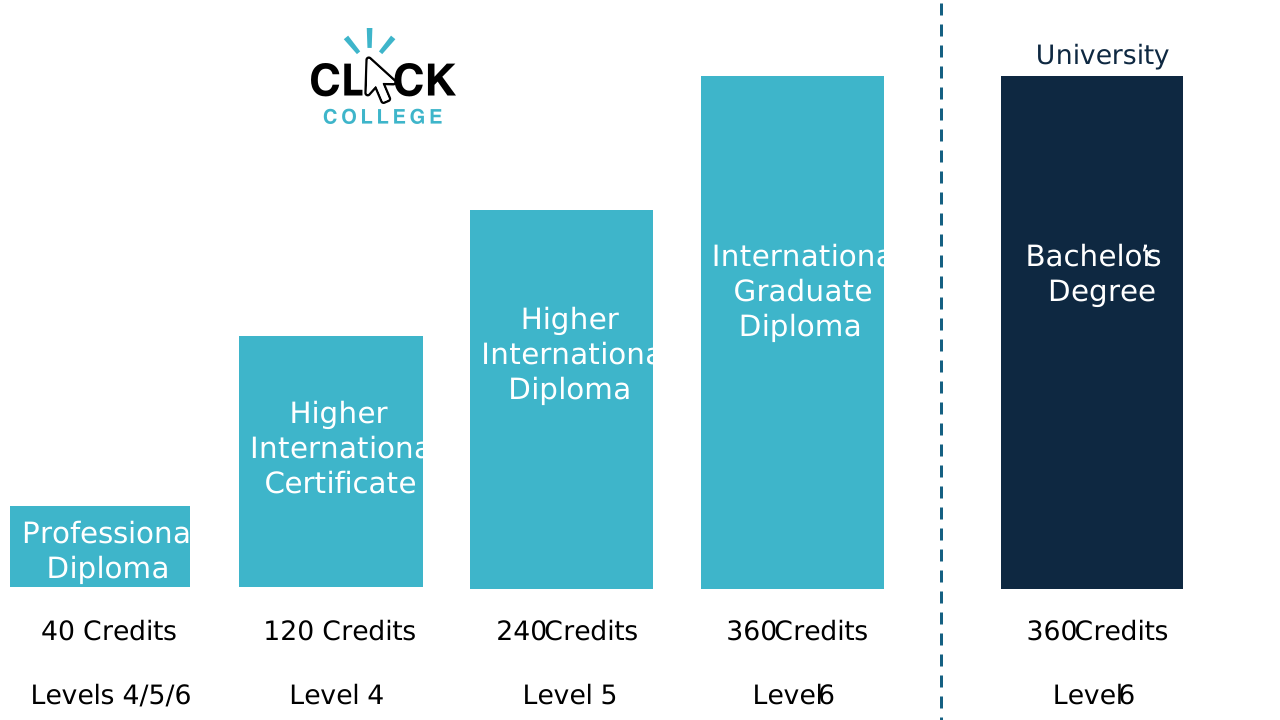
Click College offers a wide range of fully online accredited business management courses and qualifications to suit different academic backgrounds and career goals. Our programmes range from short 40 credit Professional Diplomasthrough to the 360 credit International Graduate Diploma, which is academically comparable to a bachelor’s degree. All courses are open access and available to learners worldwide.
With courses available in business management, marketing, finance, HR, hospitality & tourism and project management, Click College provides flexible learning pathways to support professional development, career progression or further study.
All Courses
Explore our courses and find a qualification that fits your goals and your schedule.
First Year of Undergraduate (Level 4 – 120 Credits)
The Higher International Certificate courses are accredited and delivered at Level 4 of the UK FHEQ framework, making them academically comparable to the first year of undergraduate study.
Years One and Two of Undergraduate (Level 5 – 240 Credits)
The Higher International Diploma courses are accredited and available with 240 Credits at Level 5 of the UK FHEQ framework, making it academically comparable to a Foundation Degree (UK) or an Associate Degree (US).
Degree-Comparable International Graduate Diploma (Level 6 – 360 Credits)
The International Graduate Diploma is accredited and delivered at Level 6 of the UK FHEQ framework. With 360 credits, it is academically comparable to a UK bachelor’s degree in terms of level and credit value.







Recent Posts
Professional Diploma or Higher Qualification Pathway: Which Should You Choose?
Professional Diploma or Higher Qualification Pathway: Which Should You Choose? Choosing the right online qualification is not always simply a question of choosing the longest course or the highest level. For many learners, the better question is: what kind of study route fits my goals right now? Some learners want a focused qualification in one […]
Professional Diploma in Leadership and Management: Course Guide
Professional Diploma in Leadership and Management: Course Guide A Professional Diploma in Leadership and Management is designed for learners who want to develop advanced leadership, strategic thinking and organisational management skills without committing immediately to a full degree programme. Leadership and management are essential in almost every sector. Whether you work in business, education, hospitality, […]
Professional Diploma in Business Management: Who Is It For?
Professional Diploma in Business Management: Who Is It For? A Professional Diploma in Business Management is designed for learners who want to build practical business knowledge without committing immediately to a full degree or long higher education programme. It can be a useful option for people who want to understand how organisations work, how teams […]