Starting Your Business Journey: The Higher International Certificate (Level 4)
Embarking on a career in business managementis a significant decision, and choosing the right starting point can make all the difference. The Higher International Certificate (HIC) from Click College offers a flexible, accessible, and globally recognised route into the profession. Whether you are beginning your educational journey or looking to retrain, the HIC provides the ideal foundation to launch your future in engineering.
An Accessible, Globally Recognised Qualification
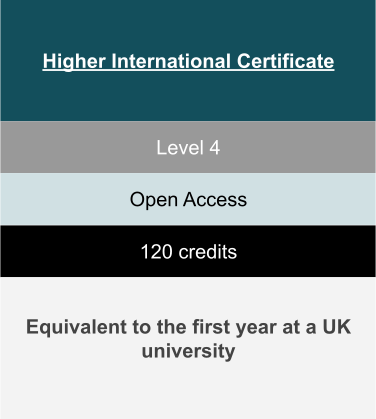
The HIC is a Level 4 qualification, carrying 120 academic credits, and is benchmarked against the first year of a UK university programme. Equivalent to qualifications such as a Higher National Certificate (HNC) or a Certificate of Higher Education, the HIC has been accredited by EduQual, a recognised UK awarding body. It is delivered entirely online, making it available to learners around the world.
One of the key advantages of the HIC is its open-access approach. There are no formal entry requirements, making it an excellent option for career changers, mature students, or anyone seeking a flexible re-entry into education. The course is designed to provide a complete introduction to the fundamentals of your chosen subject area.
Study on Your Own Terms
The HIC has been designed with maximum flexibility in mind. Learning is fully asynchronous, allowing you to study at your own pace, at times that suit your schedule. There are no exams; instead, all assessments are completed through coursework, offering a more practical and supportive way to demonstrate your understanding.
With rolling enrolment, you can start your course whenever you’re ready—there’s no need to wait for term dates or application windows.
Course Content and Structure
The HIC is made up of six modules totalling 120 credits. The programme begins with three core units that every student completes. Following these, students complete two specialised units, tailored to their chosen discipline. Finally, learners complete one optional unit from a range of subjects, allowing them to explore a secondary area of interest or broaden their knowledge beyond their specialism.
A Pathway to Further Study
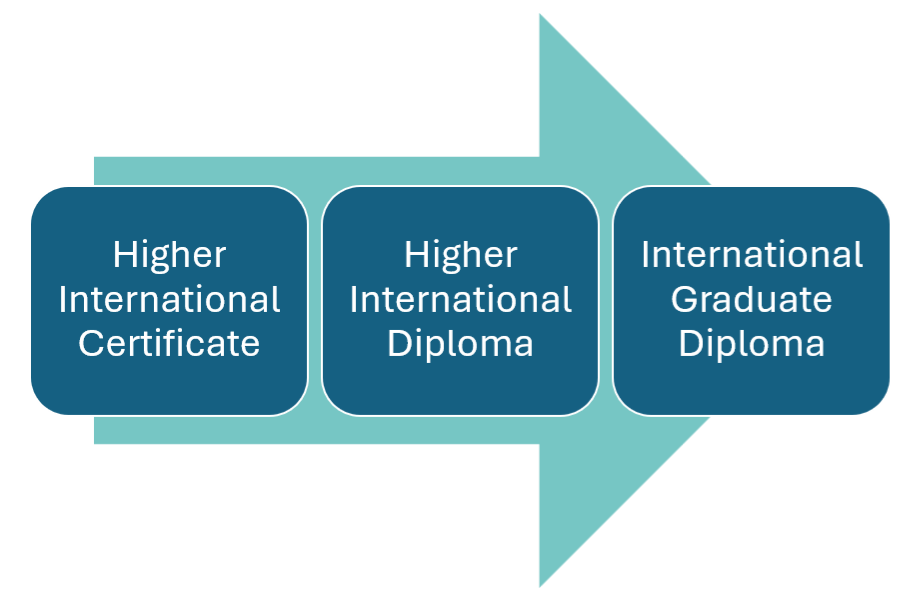
Completing the HIC is not the end of the journey—it’s just the beginning. Learners who successfully finish the programme are eligible to progress to the Level 5 Higher International Diploma (HID) and subsequently the Level 6 International Graduate Diploma (IGD). These qualifications correspond to the second and final years of a typical UK bachelor’s degree, offering a seamless path to higher-level learning.
Support Throughout Your Journey
Although the programme is delivered online, learners are never left on their own. A range of academic support options is available throughout the course, ensuring that help is at hand when needed. Tutors are accessible through email, messaging, and video conferencing, providing feedback and guidance to keep students motivated and progressing with confidence.
Who is the HIC For?
The Higher International Certificate is ideally suited to anyone looking to take their first step into their profession. Whether you’re a school-leaver without traditional qualifications, a professional considering a new direction, or an international student seeking a UK-benchmarked credential, the HIC provides a clear and supportive route forward.
With no exams, flexible pacing, and multiple progression options, it’s a programme designed to meet the needs of modern learners.
Find Out More
To find out more about this Level 4 qualification, visit the Higher International Certificate (HIC) page on the Click College website today.
Recent Posts
Professional Diploma or Higher Qualification Pathway: Which Should You Choose?
Professional Diploma or Higher Qualification Pathway: Which Should You Choose? Choosing the right online qualification is not always simply a question of choosing the longest course or the highest level. For many learners, the better question is: what kind of study route fits my goals right now? Some learners want a focused qualification in one […]
Professional Diploma in Leadership and Management: Course Guide
Professional Diploma in Leadership and Management: Course Guide A Professional Diploma in Leadership and Management is designed for learners who want to develop advanced leadership, strategic thinking and organisational management skills without committing immediately to a full degree programme. Leadership and management are essential in almost every sector. Whether you work in business, education, hospitality, […]
Professional Diploma in Business Management: Who Is It For?
Professional Diploma in Business Management: Who Is It For? A Professional Diploma in Business Management is designed for learners who want to build practical business knowledge without committing immediately to a full degree or long higher education programme. It can be a useful option for people who want to understand how organisations work, how teams […]